
Curved Glass 101: What DY-GH01, DY-JJ01, and DY-ZK01 Actually Mean
Short answer: DY-GH01, DY-JJ01 and DY-ZK01 are DYGLASS model codes for three different curved glass products. DY-GH01 is curved tempered glass made from float glass, produced in 3-19 mm thicknesses with a bending tolerance of +/-0.5 mm and light transmittance of at least 91%. DY-JJ01 is curved laminated safety glass built around a PVB interlayer, supplied in total thicknesses from 6.38 mm to 50 mm. DY-ZK01 is curved insulated glass with a low-E coating and argon fill, available in configurations such as 6+12A+6 mm and 8+16A+8 mm, with sound insulation rated at 30-45 dB. Each code describes a different construction, a different performance profile and a different job on a building.
A model code is not a specification. On a shop drawing or a bill of quantities, 'DY-GH01' or 'DY-ZK01' is a compact label, and in a quotation it is a line item. What the code actually stands for is a complete build-up: base glass, interlayer or cavity, thickness range, forming method, tolerance band and compliance route. Strip that build-up away and two options can look interchangeable when they are not.
The three codes in this article are easy to confuse because they are all curved, all produced by the same factory, and all appear in the same project conversations. In practice they answer three different questions. DY-GH01 answers how strong and how clear the glass is. DY-JJ01 answers what happens when the glass breaks and what it blocks. DY-ZK01 answers how well the glass insulates against heat, cold and noise.
Why a Model Code Is Not a Specification
Getting the mapping wrong is expensive at the decision stage, because the error is usually invisible until installation or performance testing.
- Safety assumptions. Curved tempered glass (DY-GH01) is a toughened product, but it is not the same construction as curved laminated safety glass (DY-JJ01), where the PVB interlayer holds the assembly together after breakage. Specifying one where the other is required changes the safety case for the whole opening.
- Performance assumptions. Neither tempered nor laminated curved glass delivers the thermal and acoustic performance of a curved insulated unit (DY-ZK01). A code swap here affects energy calculations, condensation risk and interior noise levels.
- Cost assumptions. Unit price per square metre and total project cost behave differently. Curved glass is where tolerance and installation fit dominate the final number, not the headline rate.
Curved glass adds a second layer of difficulty, because bending turns every specification into a geometry problem. A curved line has to control curvature, edge quality, optical distortion and residual stress at the same time. That is why tolerance, not only thickness, often decides whether a curved panel drops into its frame on the first attempt or turns into rework.
Where Curved Glass Demand Is Coming From
The commercial context explains why buyers are encountering these codes more often. Cognitive Market Research valued the global curved glass panel market at approximately USD 781.2 million in 2024 and projects a compound annual growth rate of 8.0% through 2031. Report scopes differ, and some estimates count only specific panel categories rather than all bent architectural and furniture glass, so buyers comparing figures should check what each number includes before using it in a business case.
Demand is not evenly spread. Custom Market Insights identifies Asia-Pacific as the fastest-growing region for the curved glass panel market, driven by urbanization and infrastructure development. Research and Markets reports that architectural applications such as facades and curtain walls accounted for more than 40% of curved glass panel demand in 2024. On the supply side, TrendEconomy and UN Comtrade data record China's export value for worked glass, including bent and curved glass classified under HS 7006, at approximately USD 791 million in 2023.
Competition at the top of the market is concentrated among large international groups. Global Market Insights and Grand View Research list AGC, Saint-Gobain, Guardian Industries and Cricursa, which specializes in architectural glass, among the leading players in high-performance curved glass.
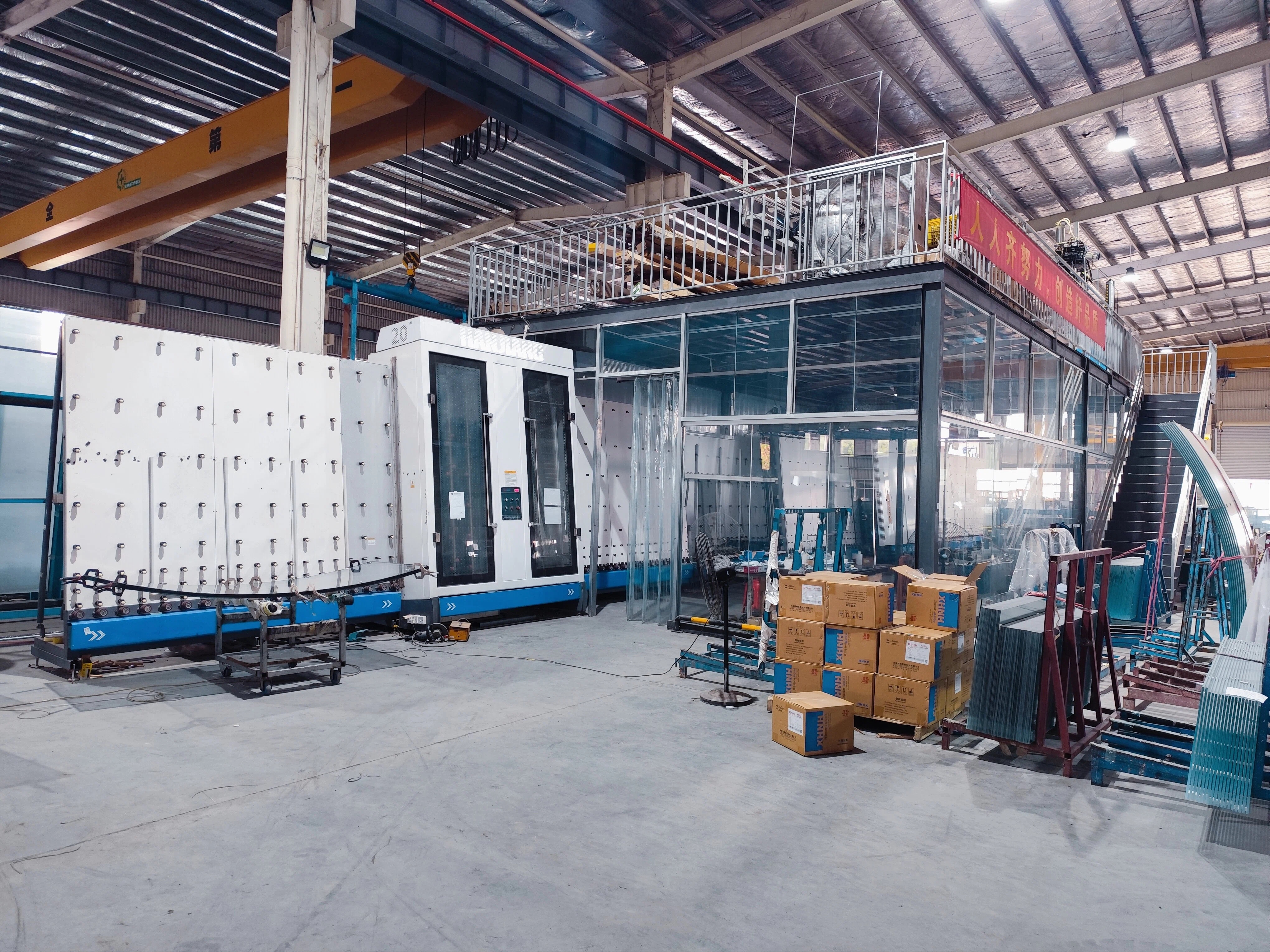
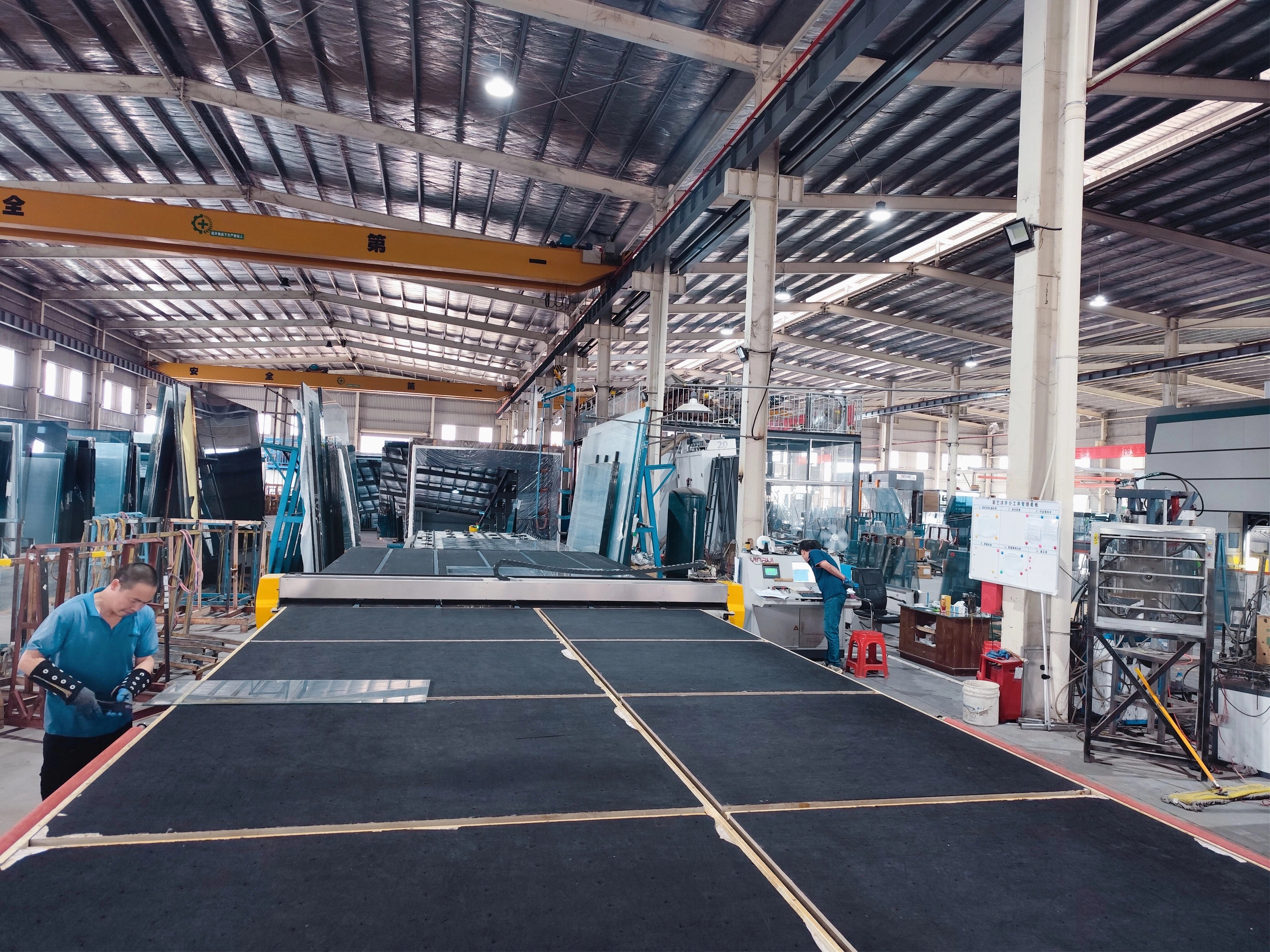
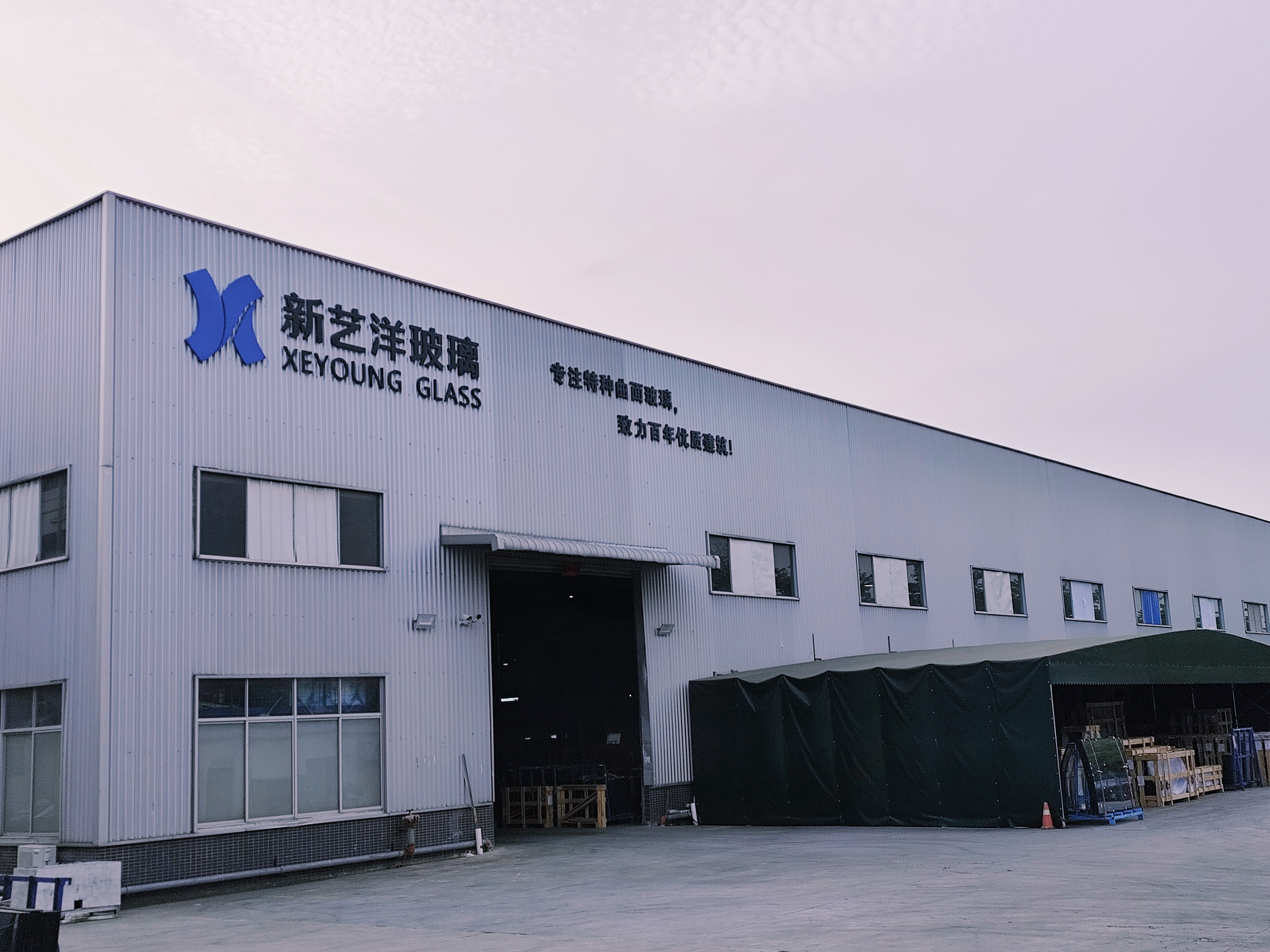
DYGLASS is the brand of Shenzhen Dayang Special Glass Co., Ltd., a building glass manufacturer based in Shenzhen and founded in 2017. The company produces laminated, toughened, smart, insulated and curved glass on a 30,000 m2 site with roughly 130 employees, a five-to-ten-person R&D team and an annual output of 600,000 square metres. Around 60% of production is exported, with main markets including the UAE, Bahrain, Saudi Arabia, the United States, the Philippines and Vietnam. DYGLASS is an Alibaba Verified Supplier and holds an SGS test report.
The Three DYGLASS Curved Glass Codes, Explained
DY-GH01 - Curved Tempered Glass: 3-19 mm, +/-0.5 mm, 91%+ Transmittance
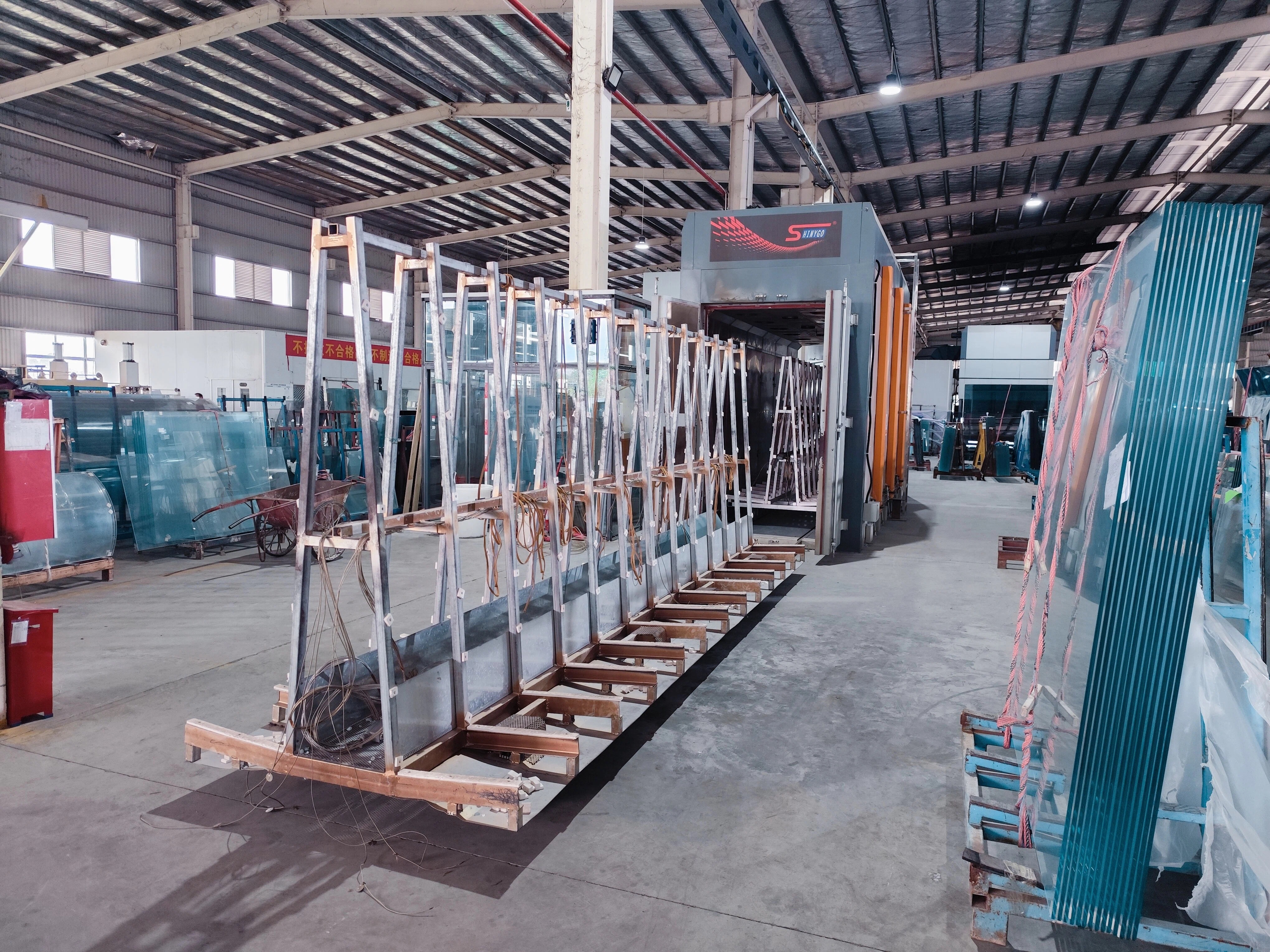
DY-GH01 is curved tempered glass produced from float glass. It is manufactured in thicknesses from 3 mm to 19 mm, formed to a bending tolerance of +/-0.5 mm, and delivers light transmittance of at least 91%. Those three numbers define the product's role: it is the code to specify when the priority is mechanical strength combined with high optical clarity in a curved geometry.
The thickness range matters more than it appears. The thinner end suits interior and furniture-scale work where weight and visual lightness dominate. The thicker end suits structural and semi-structural applications where the panel has to carry wind load, resist thermal stress and stay optically flat across a large span.
For clarity-critical installations, DYGLASS also produces ultra-low-iron curved glass with iron content of 0.01% or less and light transmittance of 91.6% or higher. This is the option that removes the green edge tint visible in standard float glass, and it is typically chosen for extra large curved glass facades, glazed elevator cabins and high-end retail frontage.
Typical DY-GH01 applications include curved glass for office partitions, curved shower room panels, curved furniture and table tops, and curved facade elements where safety glazing that resists thermal stress is required.
DY-JJ01 - Curved Laminated Safety Glass: PVB Interlayer, 6.38 mm to 50 mm
DY-JJ01 is curved laminated safety glass built with a PVB interlayer between two or more glass plies. Total thicknesses run from 6.38 mm to 50 mm, which covers everything from light interior partitions to thick, security-oriented assemblies. Lamination is the construction route that changes behaviour after breakage: the interlayer holds the assembly together rather than allowing the glass to separate.
That property is why laminated curved glass is the usual specification for overhead and fall-protection locations such as skylight roofs, canopies, balustrades and sloped glazing, and for automotive and transport glazing where retained integrity matters. It is also the construction buyers are usually looking for when they search for explosion-proof curved glass: the requirement is a safety glazing assembly, and lamination is how that is normally achieved.
Laminated constructions are also the standard route for UV block curved glass, because the interlayer sits directly in the light path between the interior and the sun.
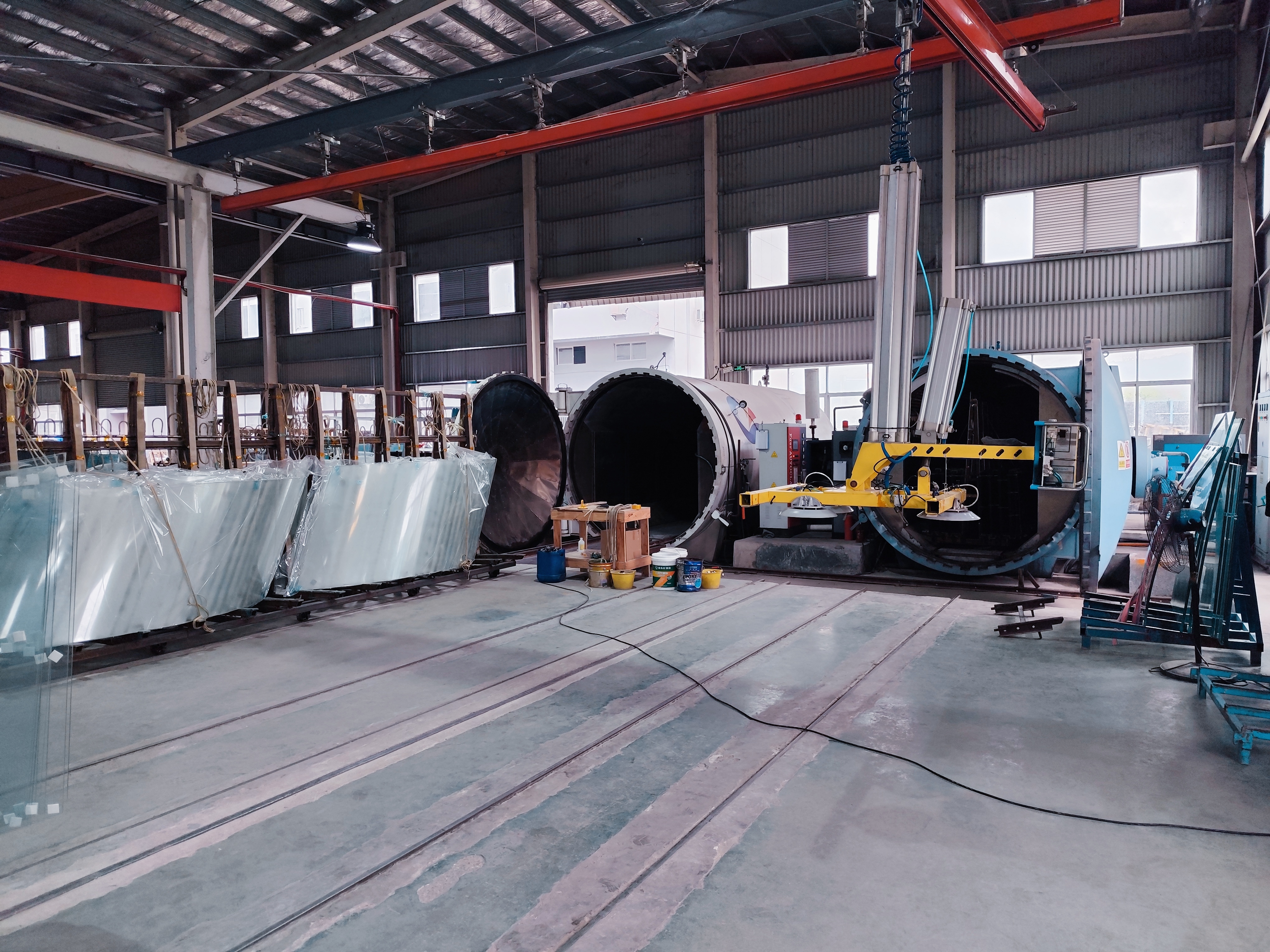
DYGLASS laminates under autoclave pressure, which is the process step that controls interlayer bond quality, edge sealing and optical clarity across a curved surface.
DY-ZK01 - Curved Insulated Glass: Low-E Coating, Argon Fill, 30-45 dB
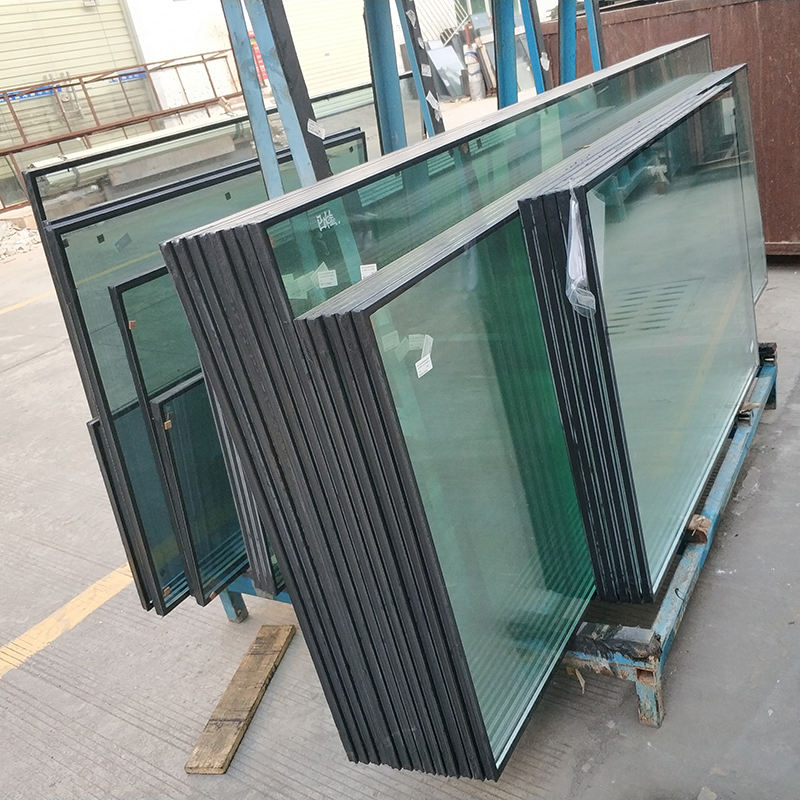
DY-ZK01 is curved insulated glass, supplied as a sealed unit with a low-E coating and an argon fill in the cavity. Standard configurations include 6+12A+6 mm and 8+16A+8 mm, where the numbers denote glass thickness, cavity width and glass thickness. Depending on the build, sound insulation is rated at 30-45 dB.
Two performance levers sit inside that description. The low-E coating reduces radiative heat transfer across the cavity, and the argon fill replaces air in the cavity with a denser gas that conducts less heat. Together they set the thermal behaviour of the unit. Cavity width and glass thicknesses set the acoustic behaviour, which is why the 30-45 dB band widens with the heavier 8+16A+8 mm configuration.
Energy performance also depends on the build. When multi-curved glass is customized with low-E or insulating layers, energy efficiency improves by 15%-25% for cooling and 10%-20% for heating compared with standard curved glass that has weaker insulation. Sealing quality determines whether that performance holds: integrated forming supports strong edge sealing, and DYGLASS reports a failure rate below 1% for leakage or fogging within ten years, against the three-to-five-year seal problems typical of standard curved glass.
DY-ZK01 is the code for curved glass for curtain wall systems, curved windows, skylight roofs and glazed sightseeing elevator enclosures, where both thermal control and acoustic control are part of the specification.
Where CE Certification Fits
For EU and EEA projects, the three codes are positioned against European standards: EN 12150-1 for thermally toughened soda lime silicate safety glass, EN 1449:2005, and the EN 1279 series for insulating glass units. EN 12150-1 is one of the safety standards that apply to toughened safety glass used in construction, and its companion standard EN 14179-1 covers heat-soaked toughened glass, the treatment used to reduce the risk of spontaneous breakage from nickel sulfide inclusions.
Documentation is part of the specification, not an afterthought. DYGLASS is an Alibaba Verified Supplier with an SGS test report, and buyers should confirm that certificates match the exact model, thickness and configuration ordered rather than the product family in general.
Step-by-Step: How to Decode and Specify a Curved Glass Code
A workable specification sequence for a decision-stage buyer looks like this.
- Start from the function, not the code. Decide whether the opening needs strength and clarity (tempered), post-break integrity and UV control (laminated), or thermal and acoustic insulation (insulated). Complex facades often need two or three of these stacked as a multi-layer build.
- Read the construction behind the code. Confirm base glass type, interlayer or cavity, coating and gas fill. This is the step that prevents a tempered code being substituted for a laminated one.
- Match thickness to load and span. Check 3-19 mm for DY-GH01, 6.38-50 mm total for DY-JJ01, and 6+12A+6 mm or 8+16A+8 mm for DY-ZK01 against wind load, dead load and acoustic targets.
- Verify tolerance and geometry capability. Curved work should be specified with an explicit bending tolerance. DYGLASS multi-curved glass holds +/-0.5-1 mm, compared with a typical +/-2-3 mm for standard curved glass, and the company forms double curved, triple curved, trapezoid, spherical, pyramidal, S-shape, cylindrical and positive-and-negative curved panels.
- Confirm structural performance for the height involved. DYGLASS multi-curved glass offers wind pressure resistance up to 96 kPa, which places super high-rise facades over 150 m within scope.
- Verify compliance for the destination market. Match the model to the relevant standard, and request the certificate for that exact configuration.
- Confirm lead time and batch economics. Standard lead time for DYGLASS multi-curved glass is 7-12 days, around 30% faster than the industry average, and automated 3/5-axis production lines reduce unit cost by 15%-25% on bulk orders compared with manual or semi-automatic processing.
- Validate before mass production. Approve curvature, edge quality and optical appearance on a sample or first article before the full order is released.
Quality control behind the code. Curved glass carries process risks that flat glass does not: overheating, thermal shock, breakage, edge chipping, scratching, warpage and deformation, and bubbles or inclusions. DYGLASS controls the thermal side with an intelligent temperature control system and infrared temperature sensors monitoring the equipment in real time, using three-level overtemperature thresholds: an early warning at 1550 degrees C, an alarm at 1580 degrees C and an emergency shutdown at 1600 degrees C. On the maintenance side, kiln refractory bricks are inspected quarterly and replaced if wear exceeds 30%, temperature sensors are calibrated on a schedule, and equipment life cycle records are kept. Those controls are what a tolerance figure actually depends on.
Use Cases: Matching Codes to Real Installations
The same geometry can call for different codes depending on what the glass has to do.
| Application | Usual code | Why it fits |
|---|---|---|
| Curved glass for curtain wall and facades | DY-ZK01, often combined with DY-GH01 or DY-JJ01 in a multi-layer build | Thermal and acoustic insulation across large glazed areas, with strength or safety layers added as required. |
| Curved glass for sightseeing elevator | DY-ZK01 with DY-JJ01 | Insulated performance for the enclosure plus laminated safety behaviour on a moving public structure. |
| Curved glass for shower room and bathrooms | DY-GH01, or DY-JJ01 where safety glazing is required | Tempered strength and clarity in wet areas; laminated where post-break integrity is specified. |
| Curved glass for coffee table and furniture | DY-GH01 | Good optical clarity and strength at the thinner end of the 3-19 mm range. |
| Curved glass for skylight roof and overhead glazing | DY-JJ01, frequently as a laminated insulated build | Lamination retains the assembly in overhead locations; insulation is added where thermal control is needed. |
| Office partitions | DY-GH01 or DY-JJ01 | Clarity and strength for interior divisions, with laminated options for acoustic and safety requirements. |
| Windows | DY-ZK01 | Insulated cavity, low-E coating and argon fill for thermal and acoustic performance. |
| Automotive glazing | DY-JJ01 | Laminated construction for retained integrity and UV control. |
DY-GH01 vs DY-JJ01 vs DY-ZK01: Side-by-Side Comparison
| Attribute | DY-GH01 | DY-JJ01 | DY-ZK01 |
|---|---|---|---|
| Construction | Curved tempered glass from float glass | Curved laminated glass with PVB interlayer | Curved insulated glass with low-E coating and argon fill |
| Thickness / configuration | 3-19 mm | 6.38-50 mm total | 6+12A+6 mm and 8+16A+8 mm |
| Key metric | +/-0.5 mm bending tolerance; 91%+ light transmittance | PVB interlayer for post-break integrity | 30-45 dB sound insulation; low-E plus argon cavity |
| Primary job | Strength with high clarity | Safety, fragment retention, UV control | Thermal and acoustic insulation |
| Typical use | Office partitions, showers, furniture, facade elements | Skylights, balustrades, automotive, overhead glazing | Curtain walls, windows, skylight roofs, sightseeing elevators |
| Relevant standard | EN 12150-1 | EN 1449:2005 | EN 1279 series |
Two practical notes follow from the table. First, these codes are not mutually exclusive: a high-performance facade panel is often a laminated insulated unit where the laminated ply carries the safety function and the insulated cavity carries the thermal function. Second, the standard column describes the compliance route each code is positioned against for EU and EEA projects, and it does not mean every configuration is automatically certified without documentation.
FAQ
Are DY-GH01, DY-JJ01 and DY-ZK01 CE compliant for EU and EEA projects?
The three DYGLASS curved glass models are positioned for CE certification referencing EN 12150-1 for thermally toughened soda lime silicate safety glass, EN 1449:2005, and the EN 1279 series for insulating glass units. EN 12150-1 is one of the European safety standards that apply to toughened safety glass used in construction, and EN 14179-1 covers heat-soaked toughened glass, the treatment used to reduce spontaneous breakage from nickel sulfide inclusions. DYGLASS is an Alibaba Verified Supplier and holds an SGS test report. Buyers should confirm that the certificates they receive match the specific model, thickness and configuration ordered.
Can DYGLASS form complex curved shapes, or only simple bends?
Shape capability goes well beyond a single curve. DYGLASS processes multi-curved tempered glass, double curved tempered glass, triple curved tempered glass, trapezoid curved tempered glass, spherical curved tempered glass, pyramidal curved tempered glass, S-shape curved tempered glass, cylindrical curved tempered glass, and positive and negative curved tempered glass. For precision work, multi-curved glass holds a bending tolerance of +/-0.5-1 mm, compared with a typical +/-2-3 mm for standard curved glass, with wind pressure resistance up to 96 kPa, enough for super high-rise facades over 150 m. Automated 3/5-axis forming lines support free-form spheres and facades, and ultra-low-iron compositions with iron content of 0.01% or less and light transmittance of 91.6% or higher support clarity-critical installations.
Does the choice of code change the total project cost?
It changes total project cost more than the unit price suggests. On-site installation loss for DYGLASS multi-curved glass is 2%, compared with 5-8% for ordinary curved glass, which reduces rework and labour. Structural stability supports a service life of over 25 years, against 8-15 years for ordinary curved glass that may crack or fog, so replacement cycles are longer. Automated 3/5-axis production lines bring unit cost for bulk orders 15%-25% below manual or semi-automatic processing. When multi-curved glass is customized with low-E or insulating layers, energy efficiency improves by 15%-25% for cooling and 10%-20% for heating compared with standard curved glass that has weaker insulation, and maintenance intervals extend to one to two years.
Can a curved glass specification be validated with a sample before ordering?
Curved glass is a case where a physical check answers questions a datasheet cannot, particularly curvature, edge quality and optical distortion. DYGLASS welcomes OEM and ODM orders and handles sample and first-article discussions through its sales team before a production order is released. Buyers can send drawings and quantities to request a sample review and a quote at info@dayangglass.com, or message the team on WhatsApp at +86 136 9211 0212.
What lead time should a project expect for curved glass?
Standard lead time for DYGLASS multi-curved glass is 7-12 days, which the company positions as around 30% faster than the industry average. Scope still affects the schedule: batch size, the number of unique curvatures, coating or lamination steps and heat-soak treatment all add process time. Lead time should therefore be confirmed against the specific configuration rather than inferred from the model code alone.
Conclusion: Read the Code, Then Read the Construction
DY-GH01, DY-JJ01 and DY-ZK01 are not three grades of the same product. They are three constructions with three different jobs. DY-GH01 delivers curved tempered glass from float glass in 3-19 mm thicknesses, at +/-0.5 mm bending tolerance and 91% or higher light transmittance, for applications where strength and clarity matter most. DY-JJ01 delivers curved laminated safety glass with a PVB interlayer from 6.38 mm to 50 mm, for locations that need retained integrity, UV control and protection overhead or in public areas. DY-ZK01 delivers curved insulated glass with low-E coating and argon fill in 6+12A+6 mm and 8+16A+8 mm builds, rated at 30-45 dB sound insulation, for curtain walls, windows, skylight roofs and glazed elevators.
For decision-stage buyers, the reliable sequence is to define the function first, confirm the construction, verify tolerance and compliance for the destination market, and then lock lead time and cost. That order prevents the most common and most expensive error in curved glass procurement: buying the right shape in the wrong construction.
Next Step: Get the Curved Glass Specification Confirmed
DYGLASS supplies CE-certified curved glass for EU and EEA projects, with OEM and ODM capability, a 30,000 m2 production base and a 7-12 day standard lead time on multi-curved glass. Share your drawings, curvature requirements and quantities to receive a configuration-matched quotation and sample guidance.
Email: info@dayangglass.com | Tel / WhatsApp: +86 136 9211 0212 | Web: www.dayangglass.com
Have Questions or Need More Details?
Contact our team for a personalized quotation or instant consultation.
Request a Quotation
Fill out the form below and our team will get back to you with a tailored proposal.
WhatsApp Direct Chat
Prefer to chat in real-time? Message us on WhatsApp for instant assistance & quick answers.
- Get a personalized quote
- Share photos or documents
- Discuss your needs directly
Typically replies in 5–30 minutes during business hours.