
Tempered vs. Laminated Glass: A Head-to-Head Decision for Curtain Walls and Safety Applications
The choice between tempered glass and laminated glass is not a choice between strength and safety. It is a choice about which failure mode a curtain wall, partition or safety glazing system has to survive — and that answer is set by the location, height, loading and post-breakage requirement of each panel, not by preference.
Tempered glass, represented in this comparison by the DYGLASS model DY-GH01, is a heat-treated monolithic pane offered from 3 mm to 19 mm thick, with a light transmittance of ≥91%. Laminated glass, model DY-JJ01 from the same manufacturer, is a multi-layer assembly bonded with a PVB, SGP or EVA interlayer, available from 6.38 mm to 50 mm and delivering sound insulation of 35–45 dB. Both product families are CE certified for the European Union and European Economic Area, and both can be produced flat, curved, drilled and edge-worked.
What follows is a working decision framework for architects, façade engineers, curtain wall contractors and project buyers who must commit one of the two to a specification — and who need to know where each product stops being the right answer.
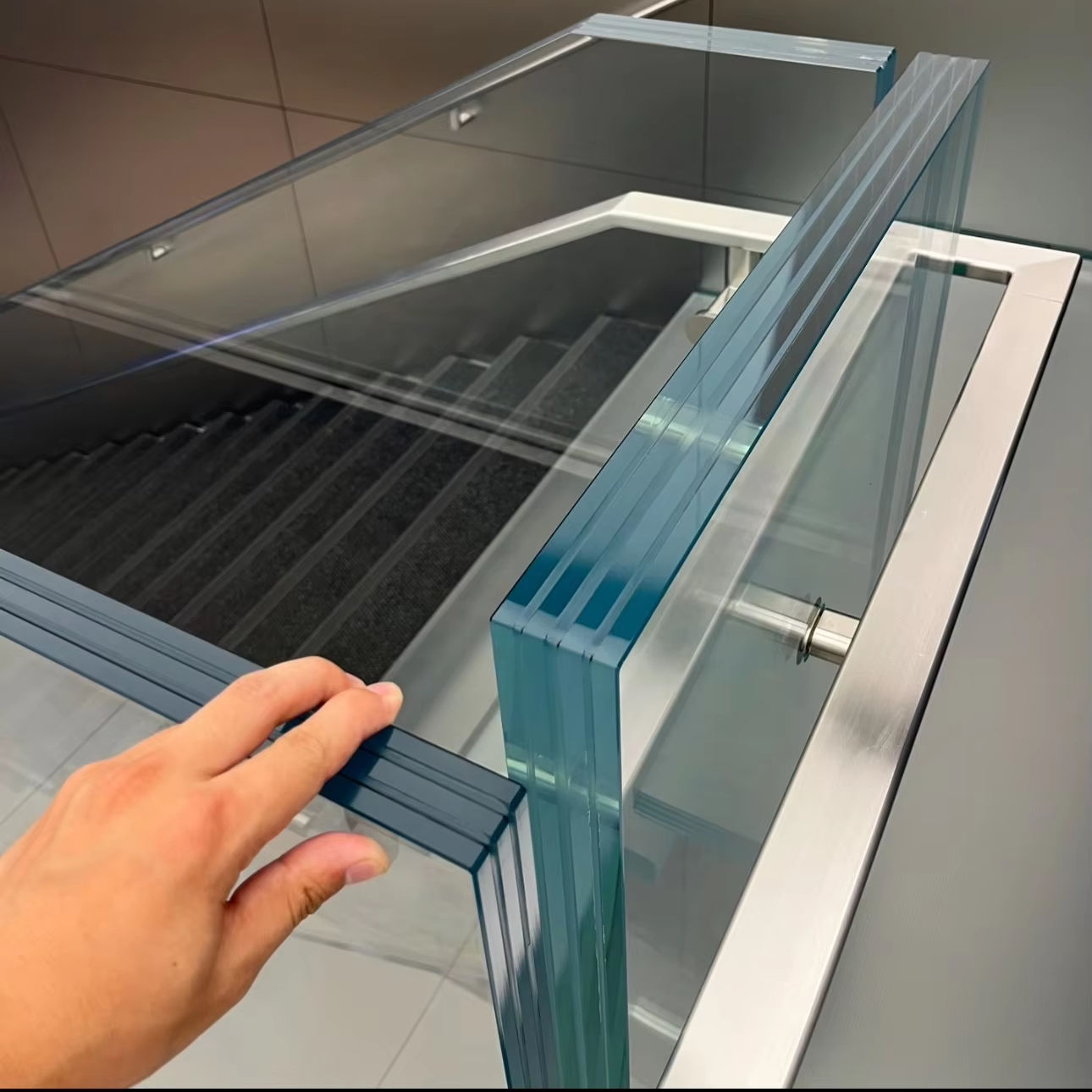
The Decision Problem: Strength Against Breakage vs. Retention After Breakage
Tempered glass is engineered to resist. Heat treatment places the glass surface under high compression, which raises resistance to thermal shock and mechanical impact, and makes the pane fragment into small, comparatively blunt pieces when it does eventually fail. ASTM C1048 requires a minimum surface compression of 10,000 psi (69 MPa) for fully tempered glass, and fragmentation performance is tested under EN 12150, which specifies 40 or more particles within a 50 × 50 mm area.
Laminated glass is engineered to hold. The interlayer bonds the glass layers together so that the assembly maintains its position in the frame after a break — the behaviour a balustrade, overhead glazing panel, skylight or high-rise façade needs when the consequence of a falling pane is unacceptable.
The practical difficulty is that most envelopes contain both conditions at once. A curtain wall elevation may need an optically clean, thermally stable monolithic pane across the vision area, while an adjacent canopy, railing infill or roof access panel needs post-breakage retention. Using one product family across an entire building is where specification errors and unnecessary cost are created, in both directions:
- Over-specifying laminated glass where only thermal-shock resistance and impact strength are required adds interlayer cost, weight and edge-condition complexity without changing the safety outcome.
- Over-specifying tempered glass where post-breakage retention is required leaves the assembly with no residual load-carrying capability once a single pane fragments.
There is also a third position that buyers often overlook: the two materials are not mutually exclusive. In the DY-JJ01 configuration list, tempered laminated safety glass is a standard build — a tempered substrate combined with an interlayer — which gives a designer both the strength of a heat-treated pane and the retention behaviour of a laminated assembly.
Industry Background: Two Glass Families, Two Regulatory Tracks
Architectural glass accounts for nearly 70% of global flat glass production, which exceeds 120 million metric tons annually, according to Business Research Insights. The global construction glass market was valued at USD 119.2 billion in 2025 and is projected to reach USD 189.33 billion by 2034, based on Fortune Business Insights data — a trajectory that reflects how much of a modern building envelope is now glass rather than masonry.
Trade data underlines where a large share of that processing capacity sits: China exported USD 676 million in the category 'Glass with Edge Workings' in 2024, representing 22% of total global exports in that category, according to the Observatory of Economic Complexity (OEC).
Regulation has moved along two separate tracks that mirror the two material families:
- Tempered glass is governed by European standards such as EN 12150-1 and EN 12150-2, which cover definition, description and conformity assessment of thermally toughened soda lime silicate safety glass, including the fragmentation requirement described above.
- Laminated glass is governed by its own product standard set and interlayer performance rules, with the CE mark issued under the Construction Product Regulation, 305/2011/EU (CPR).
For a purchaser, the practical consequence is that a supplier's certificate is normally issued per product family and per thickness configuration. A CE certificate covering laminated glass does not automatically cover tempered glass from the same factory, and vice versa. Verification has to be done family by family against the thickness combination actually being ordered.
Detailed Solution: How DY-GH01 Tempered Glass and DY-JJ01 Laminated Glass Differ in Specification
DYGLASS — the trading name of Shenzhen Dayang Special Glass Co., Ltd., a Shenzhen-based building glass manufacturer founded in 2017 — produces both product families from a 30,000 m² facility with 130 employees, an annual output of 600,000 square meters, and an export ratio of 60%. Its OEM and ODM business serves markets including the United Arab Emirates, Bahrain, Israel, the United States, Vietnam, the Philippines and Africa. That manufacturing footprint matters to this decision because the choice between tempered and laminated is only worth making if the supplier can actually deliver both options at the thickness and configuration the specification calls for.
Tempered glass — DY-GH01
DY-GH01 is a thermally tempered safety glass produced from float glass substrate. Its documented specification is:
- Thickness: 3 mm, 4 mm, 5 mm, 6 mm, 8 mm, 10 mm, 12 mm, 15 mm and 19 mm — a 3–19 mm range.
- Tolerance: ±0.5 mm.
- Light transmittance: ≥91%.
- Edge work: polished, ground or beveled.
- Configurations: flat tempered glass, curved tempered glass, tempered glass with holes, polished edge.
- Stated applications: construction, furniture, bathroom, curtain wall and office partition.
Because it is monolithic, DY-GH01 gives the designer one predictable layer to detail: a single glass line, a single edge condition, and a single set of tolerances. That simplicity is why it dominates vision glazing, doors, partitions and interior screens. Heat-soaked tempered glass is also available for projects where the specification calls for heat soak treatment to reduce the risk of spontaneous breakage from nickel sulphide inclusions — the process is carried out in a dedicated heat soak furnace at the plant.
Laminated glass — DY-JJ01
DY-JJ01 is a laminated safety glass assembly built from two or more glass layers bonded with an interlayer. Its documented specification is:
- Thickness range: 6.38 mm to 50 mm, depending on glass ply thickness and interlayer count.
- Interlayer type: PVB, SGP or EVA.
- Interlayer thickness: 0.38 mm, 0.76 mm, 1.14 mm, 1.52 mm or 2.28 mm.
- Glass substrate: tempered glass, float glass, low-iron glass or tinted glass.
- Light transmittance: 85%–92% for clear builds, 10%–70% for tinted builds.
- Sound insulation: 35 dB to 45 dB.
- Configurations: tempered laminated safety glass, bulletproof laminated glass, fire-resistant laminated glass, curved laminated glass.
- Stated industries: building and construction, real estate, architecture, interior design, automotive and solar energy.
The interlayer choice is the most consequential sub-decision inside the family. PVB is the standard architectural choice for general safety glazing, SGP is normally selected where higher post-breakage stiffness and structural performance are needed, and EVA is used where its processing or optical characteristics suit the build. The number of interlayers and their thickness (from 0.38 mm to 2.28 mm) directly affect stiffness, acoustic performance and weight.
Where the two families overlap
Three overlap zones are worth stating explicitly, because they are where most specification value is captured:
- Curved geometry. DY-GH01 is available as curved tempered glass, and DY-JJ01 as curved laminated glass. DYGLASS processes multi-curved, double curved, triple curved, trapezoid curved, spherical curved, pyramidal curved, S-shape curved, cylindrical curved, and positive and negative curved tempered glass — so a curved façade does not automatically force a compromise between strength and retention.
- Certification. Both families carry CE certification issued under the same regulatory route, with separate certificate numbers per product family.
- Combination builds. Tempered laminated safety glass sits inside the DY-JJ01 configuration list, which means the two products in this comparison can be specified as one assembly rather than as alternatives.
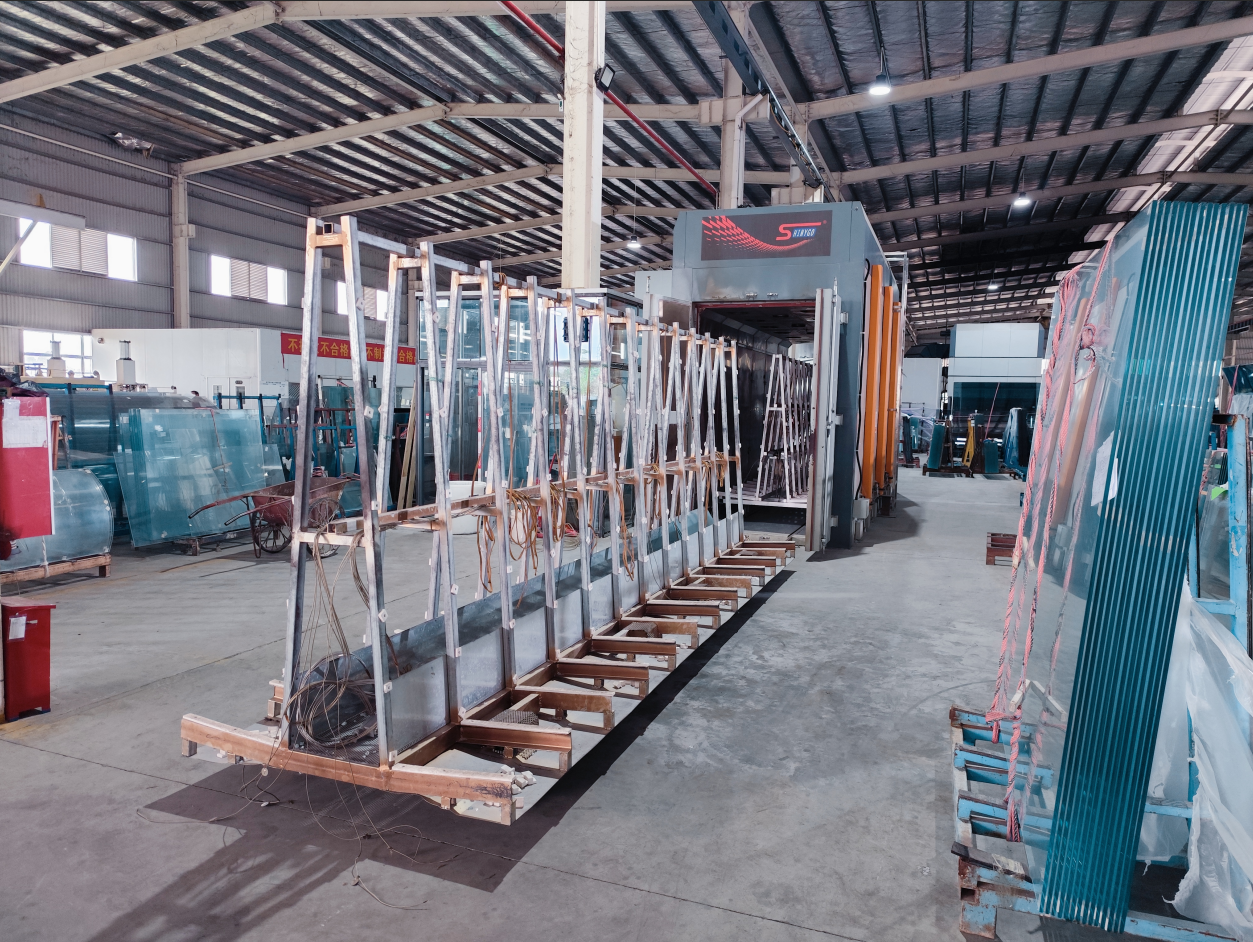
Step-by-Step: How to Choose for a Curtain Wall or Safety Application
The framework below sequences the decision so that safety requirements are resolved before commercial ones. It applies to a single panel or to a full elevation.
- Define the failure mode that matters. Ask what happens to the panel after a break. If fragments must stay in the frame — overhead glazing, balustrades, roof glazing, sloping glazing, and any location above occupied space — the assembly needs an interlayer, which means laminated glass. If the requirement is impact and thermal-shock resistance in a vertical, non-overhead location, a tempered monolithic pane is normally the more direct answer.
- Check whether the location mandates post-breakage retention. Local building codes and project specifications frequently name safety glazing classes for doors, side panels, railings and overhead conditions. Resolve these clauses before selecting thickness or interlayer, because they remove the 'either/or' question entirely in those locations.
- Fix the thickness band against the structural and deflection requirement. DY-GH01 covers 3–19 mm; DY-JJ01 covers 6.38–50 mm. Where the structural calculation pushes past what a single tempered ply can deliver within the allowable deflection, a laminated build — or a tempered laminated build — is usually the more efficient route than simply increasing monolithic thickness.
- Choose the interlayer only if laminated glass has been selected. Compare PVB, SGP and EVA against post-breakage stiffness, acoustic requirement and processing route, then set the interlayer thickness from the 0.38 mm, 0.76 mm, 1.14 mm, 1.52 mm or 2.28 mm options.
- Resolve optical and thermal requirements at the same time. DY-GH01 delivers ≥91% light transmittance. DY-JJ01 delivers 85%–92% in clear builds and 10%–70% in tinted builds. If the design intent is maximum clarity, low-iron glass as a laminated substrate keeps the assembly closer to the tempered figure; if the intent is solar control, a tinted or coated build is the relevant route rather than a change of product family.
- Check whether the answer is a combination rather than a choice. Tempered laminated safety glass, curved laminated glass, bulletproof laminated glass and fire-resistant laminated glass are all standard DY-JJ01 configurations. Where a project needs both strength and retention, the combination build resolves the conflict without changing supplier.
- Verify certification against the exact configuration being ordered, then validate before shipment. CE certificates are issued per product family and per thickness configuration, so the submittal must be checked against the family being supplied. Production quality control at DYGLASS is described as 100% test, and the standard acceptance criterion is a pre-shipment test.
Decision shortcut: vertical, non-overhead, impact and thermal-shock driven → tempered glass (DY-GH01). Anywhere fragments must remain in the frame, or where acoustic, security or fire performance is required → laminated glass (DY-JJ01). Both conditions present → tempered laminated glass.
Use Cases: Where Each Glass Type Earns Its Place
Curtain walls and high-rise façades
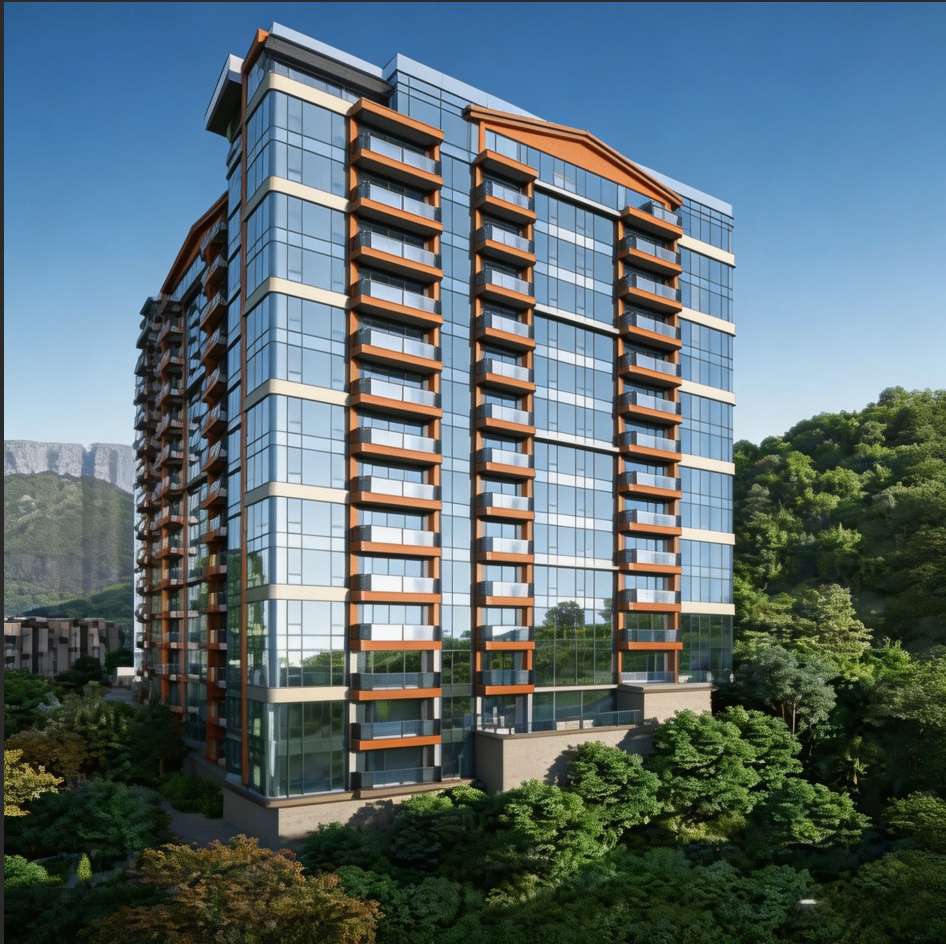
Curtain wall is listed among the stated applications of DY-GH01, and laminated glass from DYGLASS is supplied into curtain wall and façade packages. In practice the two often share one elevation: tempered glass across vision glazing where thermal shock and wind loading govern, and laminated glass where the panel geometry, height or interior occupancy below creates a post-breakage requirement. Architecturally exposed curved panels can be met in either family, including double curved and multi-curved tempered glass where the geometry is complex.
Office partitions and interior glazing
Office partition is a stated application for tempered glass. Interior screens usually prioritise optical clarity and tolerance control, which favours a monolithic tempered pane at ≥91% light transmittance. Where a partition is also an acoustic barrier, laminated glass becomes relevant: DY-JJ01 provides sound insulation of 35–45 dB, and the interlayer count can be increased to raise that performance.
Safety glazing and security applications
Balustrades, railing infill, door panels and overhead glazing sit in the laminated family because they must retain fragments. Two specialised laminated configurations extend the same logic into higher threat levels: bulletproof laminated glass for security-sensitive openings, and fire-resistant laminated glass for compartments where fire performance forms part of the glazing requirement.
Hospitality and commercial projects
DYGLASS building glass has been used by construction and engineering companies, door and window manufacturers, and hotel and commercial project purchasers. One documented application is a hotel architectural glass project in the United Arab Emirates covering 4,000 square meters, where the selection was made on heat insulation, sound insulation and appearance — a combination that typically involves laminated and insulated assemblies rather than a single monolithic pane.
Comparison Table: Tempered Glass (DY-GH01) vs. Laminated Glass (DY-JJ01)
| Decision factor | Tempered glass — DY-GH01 | Laminated glass — DY-JJ01 |
|---|---|---|
| Thickness range | 3–19 mm (3, 4, 5, 6, 8, 10, 12, 15, 19 mm) | 6.38–50 mm |
| Thickness tolerance | ±0.5 mm | — |
| Light transmittance | ≥91% | 85%–92% (clear); 10%–70% (tinted) |
| Interlayer | None — monolithic pane | PVB, SGP or EVA; 0.38, 0.76, 1.14, 1.52 or 2.28 mm |
| Glass substrate | Float glass | Tempered glass, float glass, low-iron glass or tinted glass |
| Sound insulation | — | 35–45 dB |
| Configurations | Flat tempered, curved tempered, tempered with holes, polished edge | Tempered laminated safety glass, bulletproof laminated glass, fire-resistant laminated glass, curved laminated glass |
| Edge work | Polished / ground / beveled | — |
| Stated industries | Construction, furniture, bathroom, curtain wall, office partition | Building and construction, real estate, architecture, interior design, automotive, solar energy |
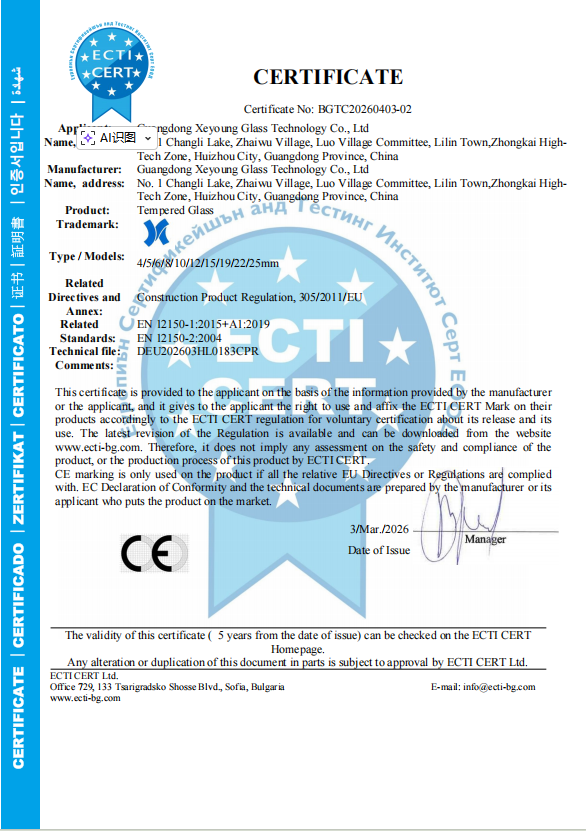
| CE certificate | BGTC20260403-02 — EN 12150-1:2015+A1:2019; EN 12150-2:2004 | BGTC20260403-03 |
| Role in an assembly | Primary strength layer; thermal-shock and impact resistance in a vertical pane | Safety layer that retains fragments after breakage; adds acoustic and security performance |
Certificates for both families were issued by ECTI CERT Ltd. on 3 March 2026 and remain valid until 3 March 2031 under the Construction Product Regulation, 305/2011/EU (CPR), for the European Union and European Economic Area market.
FAQ
Are DYGLASS tempered and laminated glass CE certified for EU and EEA projects?
Yes. Both product families hold CE certification issued by ECTI CERT Ltd. on 3 March 2026 and valid until 3 March 2031 under the Construction Product Regulation, 305/2011/EU (CPR), for the European Union and European Economic Area market. Tempered glass (DY-GH01) is covered by certificate BGTC20260403-02, which references EN 12150-1:2015+A1:2019 and EN 12150-2:2004. Laminated glass (DY-JJ01) is covered by certificate BGTC20260403-03. Insulated glass (DY-ZK01) is covered separately by certificate BGTC20260403-05 under EN 1279-1, EN 1279-2, EN 1279-3 and EN 1279-4:2018. Because certificates are issued per product family and per thickness configuration, buyers should match the certificate scope to the exact build being ordered.
Can tempered and laminated glass be combined, curved or customized for complex façades?
Yes. DY-JJ01 includes tempered laminated safety glass, curved laminated glass, bulletproof laminated glass and fire-resistant laminated glass as standard configurations, which allows a single assembly to deliver both heat-treated strength and post-breakage retention. Customization covers size, thickness, shape, tempering, insulating glass, laminated glass, hot bending, coating, ultra-clear glass, fire-resistant glass and smart switchable glass. On the curved side, DYGLASS processes multi-curved, double curved, triple curved, trapezoid curved, spherical curved, pyramidal curved, S-shape curved, cylindrical curved, and positive and negative curved tempered glass. Production is offered under both OEM and ODM models.
What commercial terms apply, and what drives cost within each glass family?
The minimum order quantity is 10 square meters. Delivery terms available are EXW, FOB, CIF, CFR, DAP and DDP, and payment terms are TT or LC. Within each family, the variables that normally move cost are the total glass thickness, the interlayer type and count for laminated builds, the substrate choice (clear, low-iron or tinted), the edge work and hole drilling requirement, heat soak treatment for tempered glass, and the geometric complexity of curved panels. Comparing a tempered quotation with a laminated quotation is therefore only meaningful when thickness, substrate, edge condition and geometry are held constant.
How is quality validated before shipment?
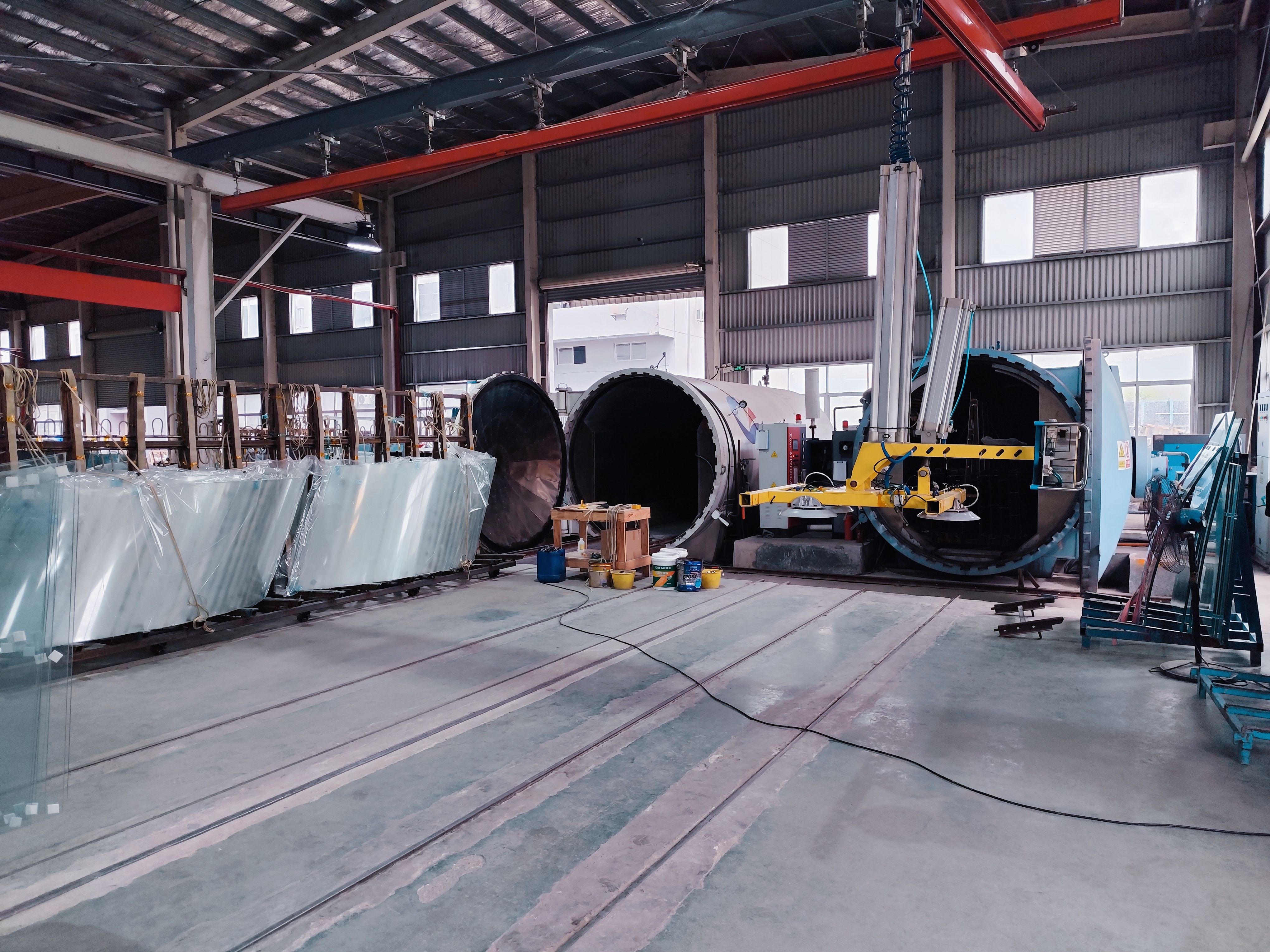
Production quality control at DYGLASS is 100% test, and the standard acceptance criterion applied to orders is a pre-shipment test. The factory operates a 30,000 m² facility with 130 employees and an annual output of 600,000 square meters, and the production equipment relevant to this decision includes flat and curved tempering lines, a double curved tempering line, an autoclave for laminated glass bonding, an insulated line, a heat soak furnace, cutting, drilling and edge grinding lines. After-sales support includes online technical support, onsite inspection, onsite training, return and replacement, and onsite installation.
What is the lead time, and how do buyers take the next step?
Standard lead time is 7–9 days, with a minimum order quantity of 10 square meters. Buyers evaluating tempered versus laminated glass for a specific project can request a sample or a project-specific quotation by emailing info@dayangglass.com or contacting the sales team on WhatsApp at +86-136 9211 0212. The full product brochure is available for download at the DYGLASS brochure page.
Conclusion: Decide by Failure Mode, Then by Specification
Tempered glass and laminated glass are not competing answers to the same question. DY-GH01 solves for resistance — thermal shock, impact and predictable fragmentation in a monolithic pane of 3–19 mm with ≥91% light transmittance. DY-JJ01 solves for retention — an interlayer bonded assembly of 6.38–50 mm with PVB, SGP or EVA options, 35–45 dB sound insulation, and configurations that extend to bulletproof and fire-resistant performance.
The decision sequence that avoids both over-specification and under-specification is short: identify the failure mode the panel must survive, confirm whether post-breakage retention is required at that location, size the thickness band against the structural requirement, then choose the interlayer only if the laminated route has been selected. Where a project needs both behaviours, tempered laminated glass removes the trade-off altogether.
For curtain walls, partitions, balustrades and safety openings, the specification that performs correctly is the one that matches the material to the failure mode of each panel — and the supplier that can deliver both families, certify them, and curve them, keeps that decision open for the whole envelope.
Request a sample or project quotation
Send your panel schedule — thickness, glass type, interlayer preference, geometry and destination market — and the DYGLASS team will confirm the correct configuration, certification scope and lead time.
Email: info@dayangglass.com | WhatsApp: +86-136 9211 0212 | Website: www.dayangglass.com | Brochure: download PDF
Shenzhen Dayang Special Glass Co., Ltd. — trading as DYGLASS — is a building glass manufacturer founded in 2017, producing laminated glass, toughened (tempered) glass, smart glass, insulated glass, curved glass and building glass for projects worldwide.
Have Questions or Need More Details?
Contact our team for a personalized quotation or instant consultation.
Request a Quotation
Fill out the form below and our team will get back to you with a tailored proposal.
WhatsApp Direct Chat
Prefer to chat in real-time? Message us on WhatsApp for instant assistance & quick answers.
- Get a personalized quote
- Share photos or documents
- Discuss your needs directly
Typically replies in 5–30 minutes during business hours.