
Fixing Condensation and Noise in Curved Curtain Walls with DY-ZK01 Insulated Glass
Two symptoms dominate complaints about curved curtain walls and curved window systems: water on the room-side pane, and outside noise the facade was supposed to stop. Both trace back to one design decision — whether the glazing has a sealed, gas-filled cavity or is a single sheet of glass. DY-ZK01 curved insulated glass is a tempered insulated unit built around that cavity, and it is the component that decides whether a curved facade performs thermally and acoustically.
DYGLASS is the brand of Shenzhen Dayang Special Glass Co., Ltd., a Shenzhen-based building glass processor founded in 2017 that supplies tempered, laminated, insulated, smart and curved glass and exports to markets including the UAE, Saudi Arabia, Bahrain, the United States, the Philippines and Vietnam. Its curved range covers cylindrical, double-curved, multi-curved, triple-curved, trapezoid, spherical, pyramidal, S-shape and positive/negative curved tempered glass.
This article explains why condensation, heat loss and noise appear in curved curtain walls, how the insulated build addresses each of them, what to specify, and how to verify compliance — including CE certification against EN 1279-1, EN 1279-2, EN 1279-3 and EN 1279-4:2018 for European Union and EEA projects.
Problem Definition: Three Failures That Only Look Like One
Condensation, heat loss and noise are reported as separate defects, but in a curved curtain wall they usually share a single root cause: the glass assembly does not separate the warm, humid interior from the cold exterior, and it does not add enough mass and decoupling to stop sound.
Surface condensation and internal condensation are not the same defect
Surface condensation appears on the room-side face when that surface drops below the dew point of the indoor air. It is a temperature problem, not a cleaning problem, and it is worst on shaded curves, north elevations, cold-climate winter conditions and in heavily air-conditioned interiors in humid climates. The remedy is to raise the inner pane temperature, which means reducing heat loss through the glass.
Internal condensation — fogging or droplets between the panes that never clear — is a manufacturing and sealing issue. It means the desiccant in the spacer is saturated, or the primary and secondary edge seals have been breached and water vapour has entered the cavity. No site work repairs it; the unit has to be replaced. This is precisely the failure mode the EN 1279-2 long-term moisture penetration test is designed to screen out.
Heat loss follows four paths, and only one of them is the glass itself
Energy leaves a facade by conduction through the glass, by radiation across the cavity, by convection of the gas inside the cavity, and by thermal bridging at the spacer and frame. A single pane offers no cavity, so all four paths act at once. A low-E coating reduces the radiative path, a gas fill suppresses conduction and convection inside the cavity, and the spacer choice controls the edge. Ignoring any one of the three leaves a cold band that shows up later as condensation.
Noise control is limited by mass and by the weakest perimeter detail
Single glazing is mass-limited: the only barrier is the weight of one sheet. A sealed cavity decouples the two panes, and using two different thicknesses — 6 mm with 8 mm, for example — prevents both panes from resonating at the same coincidence frequency. Once the glass is correct, the perimeter becomes decisive: an unsealed frame interface or a rigid mullion connection lets sound bypass the glass entirely.
Curved geometry adds three constraints a flat unit does not have
- The cavity must stay uniform across the arc. A spacer bent without proper radius control can flatten locally, pinching the gap and creating a cold band that appears as a condensation stripe following the curve.
- Edge deletion of the low-E coating has to follow the curve; coating left under the seal compromises adhesion.
- Curved tempering introduces anisotropy and reflected wave distortion, so optical quality has to be judged on the finished unit rather than on the flat sheet.
Industry Background: Why Curved Facades Are Being Specified as Insulated
Curved glass is no longer a one-off signature item. Market research compiled for this category puts the global curved glass market at USD 13.5 billion in 2025, with a forecast CAGR of 5.8% over 2025–2035 (Statifacts). The wider glass curtain wall market was valued at USD 62.4 billion in 2024 (Grand View Research), and curved work sits at the demanding, high-specification end of that base.
Two standard families govern how the product is qualified. For the insulated unit itself, the EN 1279 series is the harmonised route to CE marking under the Construction Products Regulation 305/2011/EU: Part 1 sets generalities, system description, rules for substitution, tolerances and visual quality; Part 2 covers long-term moisture penetration; Part 3 covers gas leakage rate and gas concentration tolerances; Part 4 covers the physical attributes of edge seal components and inserts. For the glass components, EN 12150-1:2015+A1:2019 and EN 12150-2:2004 cover thermally toughened safety glass, ASTM C1464 addresses bent glass for building construction, furniture and display, and ISO 11485-3:2014 classifies curved tempered and curved laminated glass as safety glass for buildings.
That regulatory structure explains a practical shift in specification. Because the thermal and acoustic function sits inside the glass build rather than in the frame profile, an insulated curved unit can be introduced without redesigning the curtain wall system — which matters on refurbishment, on projects where the profile is already fixed, and on facades where the curved panels are a minority of the elevation but the hardest to correct later.
Detailed Solution: What DY-ZK01 Curved Insulated Glass Is
DY-ZK01 is a tempered insulated glass unit — two panes separated by a sealed spacer, filled with gas, and supplied in hot-bent curved form for curtain wall and window applications. In its documented configurations it is offered as tempered insulated glass, insulated glass with low-E coating, insulated glass with argon gas fill, and curved insulated glass, and it is intended for building construction, curtain wall and window systems, and architectural interior use.
| Parameter | Documented options for DY-ZK01 |
|---|---|
| Product type | Tempered insulated glass; low-E coated insulated glass; gas-filled insulated glass; curved insulated glass |
| Standard builds | 6 mm + 12A + 6 mm and 8 mm + 16A + 8 mm (custom available) |
| Glass substrate | Clear float, low-iron, low-E, tempered |
| Spacer bar | Aluminum spacer or warm-edge spacer |
| Gas fill | Air, argon, krypton or xenon |
| Light transmittance | 70% – 89% |
| Sound insulation | 30 – 45 dB |
| Typical application | Curtain wall, window systems, architectural and interior glazing |
Low-E coating: keeps the inner pane above the dew point
The coating is what stops the room-side pane from becoming the coldest surface in the envelope. A low-E coating reduces radiative heat exchange across the cavity, which keeps the inner pane warmer and moves its surface further away from the dew point of the indoor air. In cooling-dominated climates the same property reduces radiant heat gain. Coating surface and position are project decisions that should be confirmed with the supplier against the climate zone, not taken from a catalogue default.
Argon gas fill: suppresses conduction and convection in the cavity
Air inside a cavity is not static; it circulates and carries heat from the warm pane to the cold pane. Argon is denser and conducts less, so it lowers that transfer. DY-ZK01 is documented with air, argon, krypton and xenon options; argon is the common specification where the cavity is 12 mm or wider, with krypton and xenon generally reserved for narrower cavities where the additional cost can be justified by the performance requirement.
Aluminum or warm-edge spacer: the edge is where condensation starts
The spacer does two jobs — it holds the panes at a fixed distance, and it contains the desiccant that keeps the cavity dry. An aluminum spacer is mechanically stable and cost-efficient but conducts heat, so the glass edge runs colder than the centre of the pane. A warm-edge spacer reduces that conduction and lifts the edge temperature. Both options are documented for DY-ZK01, and the choice should follow whether edge condensation has been an issue on the project or is likely on a cold-climate elevation.
Tempered glass and curved forming: performance that survives the geometry
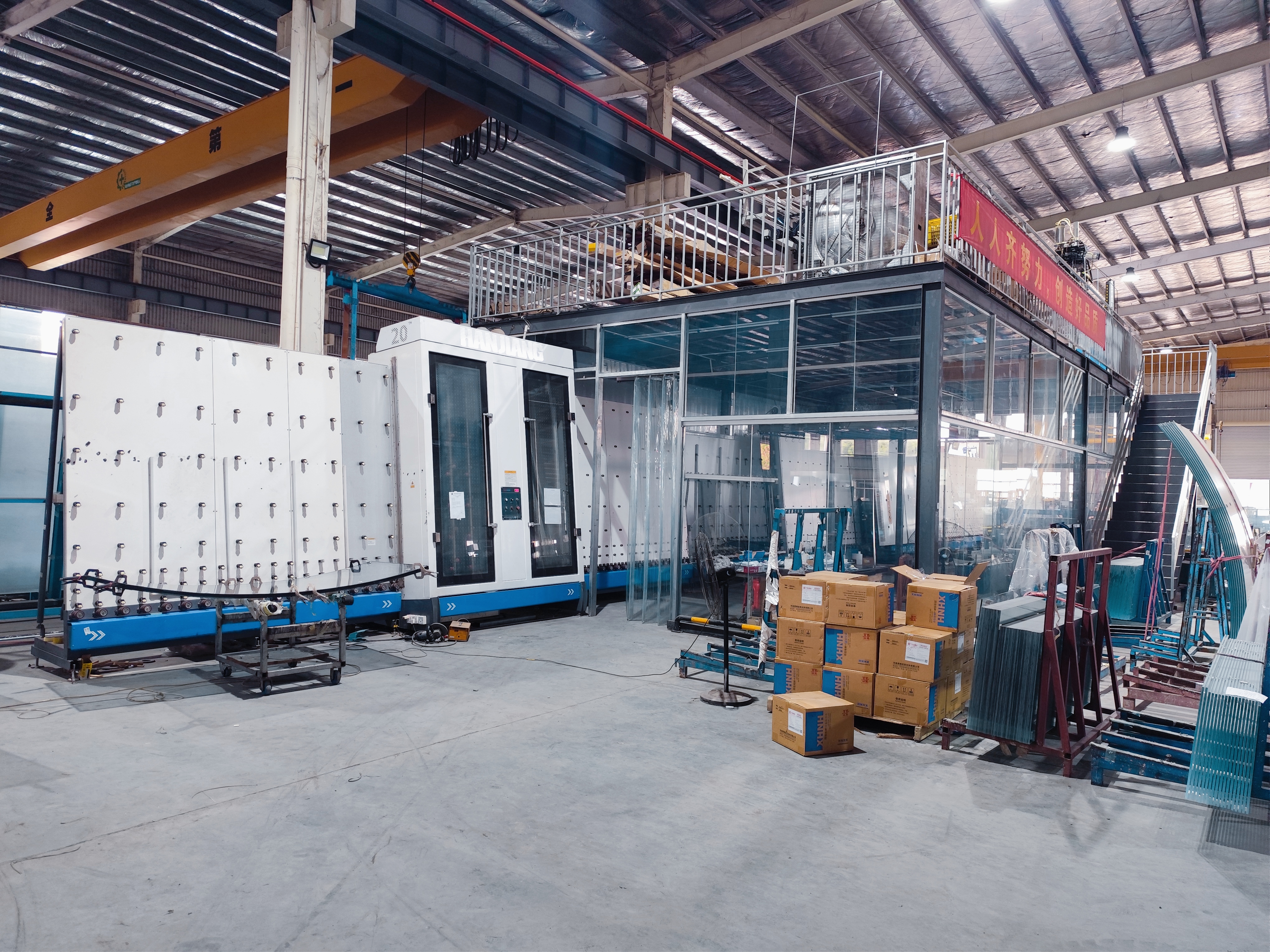
DY-ZK01 is built on tempered glass, which provides the mechanical strength and the safety behaviour of the unit. The forming step is where geometry and performance meet: the panes have to hold the specified radius without optical damage, and the spacer has to follow the same arc. The Shenzhen facility runs dedicated curved tempering capacity, including a double curved tempering line, alongside an insulated glass line, an autoclave, a heat soak furnace and cutting, drilling and edge grinding lines.
Compliance for EU and EEA Projects: EN 1279-1 to -4:2018
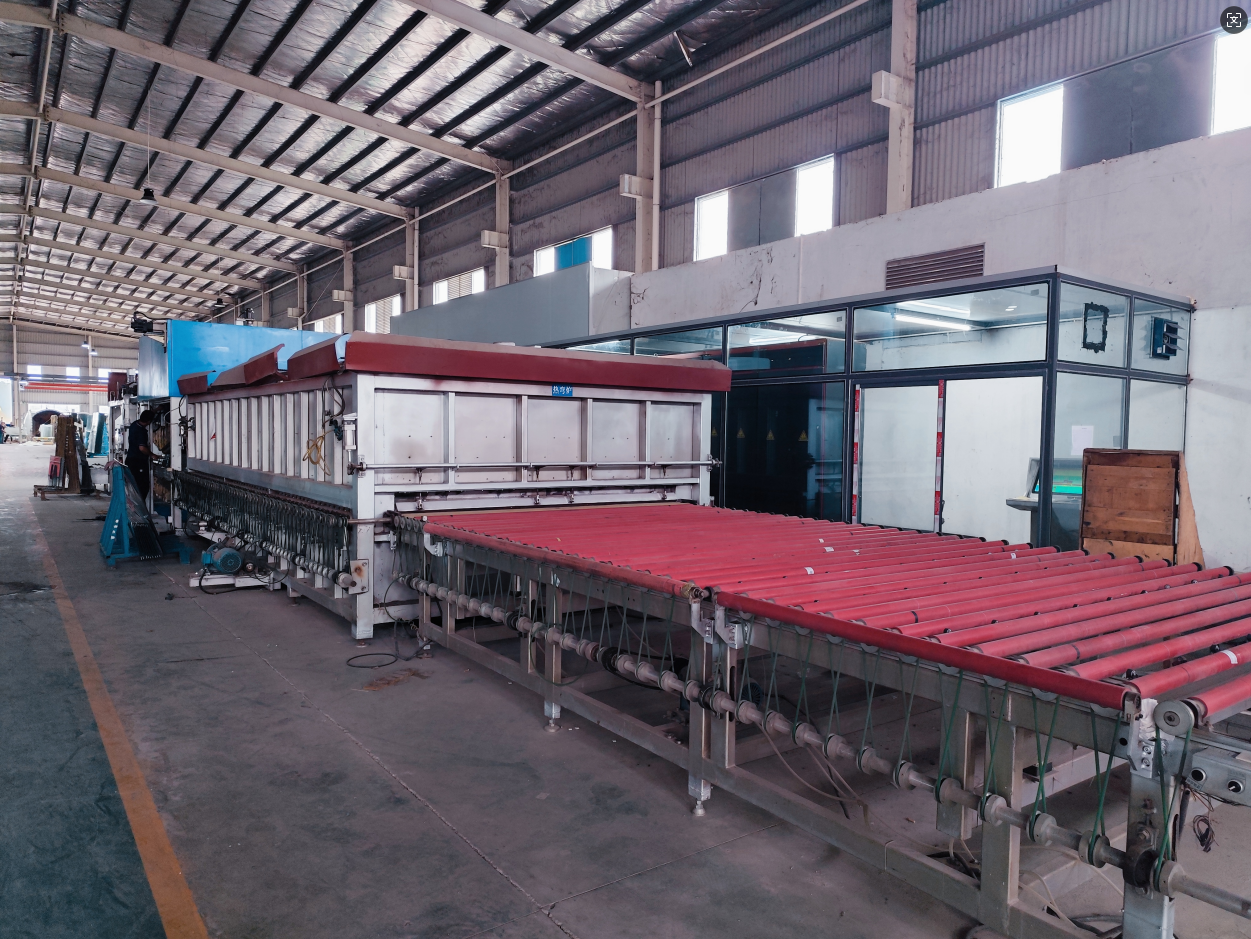
The DY-ZK01 insulated glass range is covered by CE certification under certificate BGTC20260403-05, issued by ECTI CERT Ltd. for the European Union and European Economic Area market against EN 1279-1:2018, EN 1279-2:2018, EN 1279-3:2018 and EN 1279-4:2018, together with the Construction Products Regulation 305/2011/EU. The certificate was issued on 2026-03-03 and is valid until 2031-03-03.
The tempered glass component is certified separately under certificate BGTC20260403-02 (ECTI CERT Ltd.) against EN 12150-1:2015+A1:2019 and EN 12150-2:2004, covering thickness specifications from 4 mm to 25 mm.
Practical note for specifiers: a CE certificate covers a defined scope of configurations. Before writing a certificate number into a project submittal, confirm that your specific build — glass thicknesses, cavity width, coating, gas fill, spacer type and curvature — falls inside the certified scope, and that the certificate is issued to the entity that will manufacture and declare the product. That check takes minutes and prevents a submittal rejection later.
Step-by-Step Breakdown: From Drawing to Installed Unit
The sequence below is the working order for curved insulated units. Each step closes a decision that cannot be corrected later without remaking the glass.
Step 1 — Verify the geometry, not just the drawing
Radius, chord, rise, panel size and the number of distinct curvatures determine whether a unit can be built as one piece. Industry reporting collected for this category cites bending radii down to roughly 75 mm and panel lengths up to 12 m at advanced fabricators; treat those figures as capability benchmarks to verify against your specific shape rather than as a guarantee. Send the 3D model or true-shape drawing, not a scaled elevation.
Step 2 — Fix the build before the frame
Choose between the standard 6 mm + 12A + 6 mm and 8 mm + 16A + 8 mm builds on the acoustic target, the thermal target, wind load and the weight the frame and fixings can carry. The 8/16/8 build adds mass and a wider cavity, which is the direction to take when traffic or aircraft noise is the dominant complaint; the 6/12/6 build is the lighter and more economical starting point. Custom combinations are available where neither standard build fits.
Step 3 — Select coating, spacer and gas as one system
These three components interact. A low-E coating combined with an aluminum spacer and an air fill gives up much of the edge benefit; a warm-edge spacer combined with low-E and argon performs as intended. Decide all three together and record the combination on the specification sheet, because substituting one later changes the declared performance of the whole unit.
Step 4 — Form and temper the panes
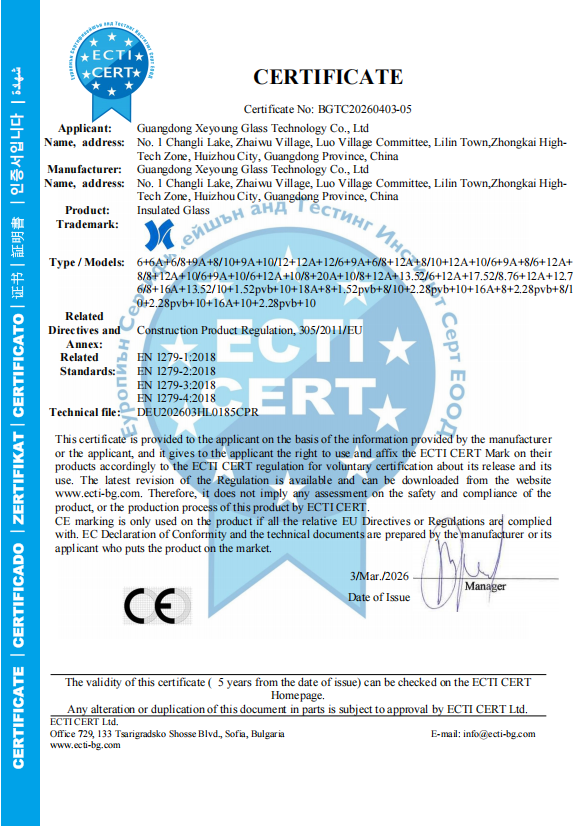
Cutting, edge grinding and drilling happen before forming, because a curved tempered pane cannot be drilled afterwards. The panes then pass through curved tempering; the double curved line covers shapes beyond simple cylindrical bending, and heat soak capacity is available for tempered glass where the project requires it.
Step 5 — Bend the spacer and build the edge seal
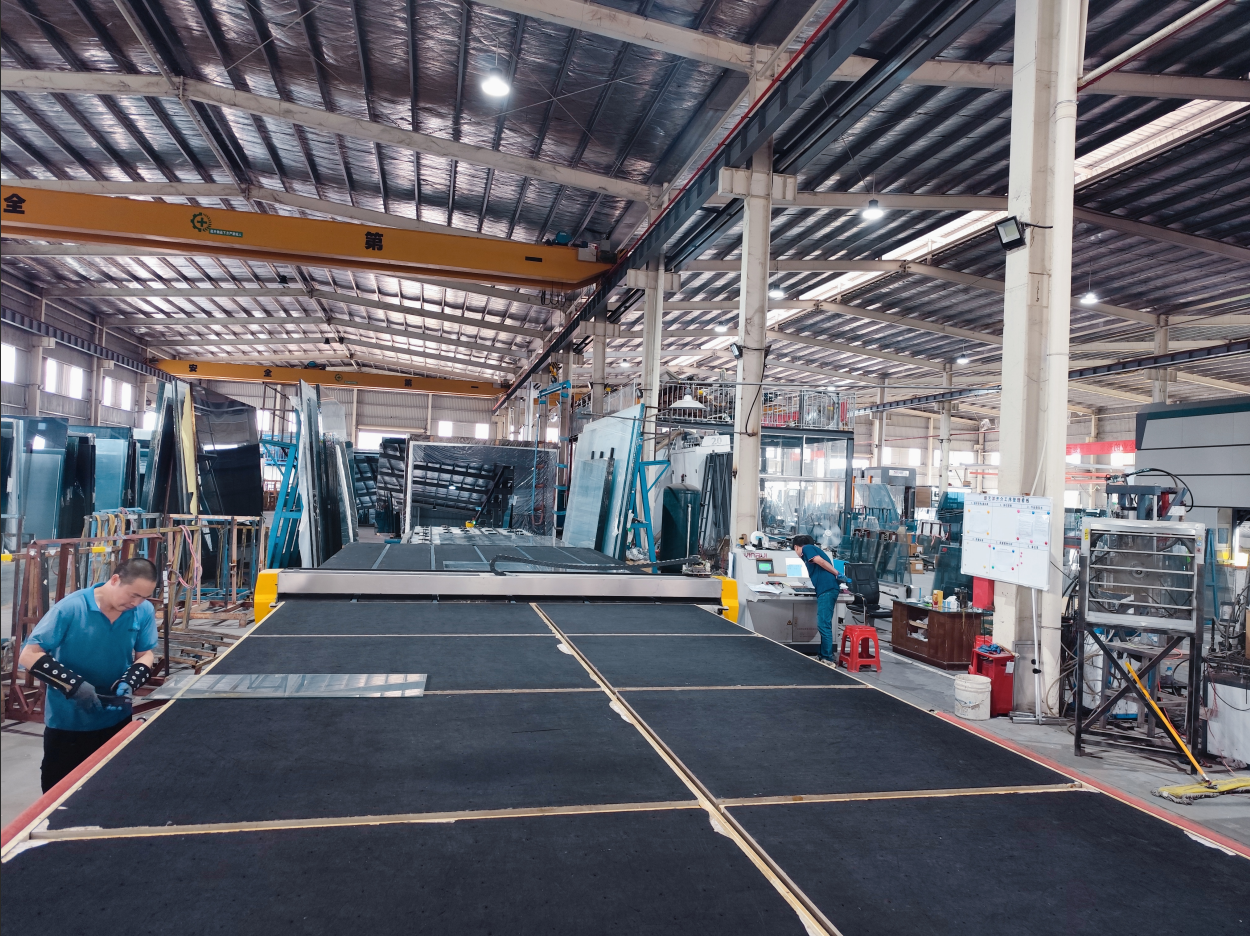
The spacer is bent to follow the same arc and filled with desiccant, then the primary seal is applied and the assembly is closed. The measurable output of this step is cavity uniformity around the perimeter; an uneven gap appears later as a condensation stripe along the curve or as visible distortion.
Step 6 — Fill the gas, apply the secondary seal and verify
Gas filling happens before the secondary seal is cured, and the retained gas concentration is what Part 3 of EN 1279 addresses. Ask for the gas fill verification record, not only the gas type stated on the datasheet, because the declared thermal and acoustic performance depends on the concentration actually retained.
Step 7 — Document, pack and coordinate installation
Curved units ship with protection matched to the curvature, and they are installed to tolerances that respect the frame's own movement. The documentation set for an EU/EEA project typically includes the CE certificate and the declaration of performance; for other markets the equivalent test reports apply. Agree the installation sequence with the facade contractor before the first panel leaves the factory.
Use Cases: Where the Insulated Curved Build Earns Its Cost
Unitized curved curtain walls on conditioned buildings
This is the core application. The inner pane stays above the dew point in winter, the low-E coating limits solar gain in summer, and argon reduces the load on perimeter heating. The benefit is largest on shaded and north-facing curves, where the exterior surface temperature is lowest and single glazing produces the coldest interior face.
Curved window replacement in existing facades
Where a building keeps its curved openings but replaces single glazing, the frame geometry is already fixed — which is exactly where an insulated build helps, because the thermal and acoustic function sits inside the glass. Weight increases, so frame and fixing capacity must be checked before the specification is released.
Atrium, skylight and roof glazing
Sloped and curved roof glass has the highest condensation exposure in a building: warm moist air rises and the underside of the roof glazing is the coldest large surface in the space. Insulated units with low-E, gas fill and a warm-edge spacer are the standard response, but the frame's thermal break and the drainage detail still have to be designed — glazing alone does not solve a roof that cannot drain.
Glazed sightseeing elevator and shaft enclosures
In cold or air-conditioned shafts, condensation forming on the inside of the glazing drips onto the car and the guide rails. An insulated curved unit moves the cold surface out of the interior and reduces that risk, and the sealed cavity also reduces the direct sound path into the shaft.
Curved vision corners and transition zones in high-rise
The corner of a tower is where frame geometry is hardest and where single glazing gives the coldest interior surface. A curved insulated unit carries the thermal and acoustic function around the corner without introducing a mullion at the tightest point of the arc.
Comparison: Curved Tempered, Curved Laminated and Curved Insulated Glass
The three DYGLASS curved product families look similar and behave differently. The table uses documented product data and the harmonised standard cited on each certificate.
| Criterion | DY-GH01 Curved Tempered | DY-JJ01 Curved Laminated | DY-ZK01 Curved Insulated |
|---|---|---|---|
| Documented build | Single tempered pane; thickness range 3–19 mm listed for the product, tolerance ±0.5 mm | Two or more glass layers with PVB, SGP or EVA interlayer; 6.38–50 mm total; interlayer 0.38–2.28 mm | Two tempered panes with sealed cavity; 6+12A+6 mm or 8+16A+8 mm standard, custom available; aluminum or warm-edge spacer; air, argon, krypton or xenon |
| Light transmittance | ≥ 91% | 85%–92% clear, 10%–70% tinted | 70%–89% |
| Sound insulation (documented) | Not stated in the product data; depends on thickness | 35–45 dB | 30–45 dB |
| Condensation behaviour at the room-side face | No cavity and no desiccant; the inner face is the coldest of the three, so surface condensation risk is highest | Interlayer adds mass and damping, but there is still no sealed cavity, so surface condensation risk remains | Sealed cavity with desiccant, low-E and gas fill; lowest surface condensation risk of the three, and the only one that manages internal cavity moisture |
| Harmonised standard on certificate | EN 12150-1:2015+A1:2019; EN 12150-2:2004 | EN 1449:2005 | EN 1279-1:2018; EN 1279-2:2018; EN 1279-3:2018; EN 1279-4:2018 |
| Best fit | Safety glazing where thermal performance is not the driver | Safety, security and overhead applications where weight and post-breakage integrity matter | Conditioned buildings, noise-exposed facades, cold-climate windows and roof glazing |
DY-ZK01 is not the automatic answer for every curved opening. Where the requirement is safety or security rather than thermal control — shower enclosures, balustrades, furniture and display tops — a single tempered or laminated curved unit is lighter and simpler, and an insulated cavity adds weight and depth without a functional return. The build should follow the function the glazing has to perform, not the product name.
Frequently Asked Questions
Does curved insulated glass need CE certification for EU and EEA projects, and which EN 1279 parts apply?
For construction works covered by the Construction Products Regulation 305/2011/EU, the insulated unit is CE marked against the EN 1279 series, and four parts apply: EN 1279-1:2018 (generalities, system description, tolerances, visual quality), EN 1279-2:2018 (long-term moisture penetration), EN 1279-3:2018 (gas leakage rate and gas concentration tolerances) and EN 1279-4:2018 (physical attributes of edge seal components). For DY-ZK01 the insulated glass certificate is BGTC20260403-05, issued by ECTI CERT Ltd., valid from 2026-03-03 to 2031-03-03; the tempered panes are covered separately by certificate BGTC20260403-02 against EN 12150-1:2015+A1:2019 and EN 12150-2:2004. Always confirm that your specific thickness, cavity, coating, gas and curvature combination sits inside the certified scope.
Can DY-ZK01 be supplied as a curved unit, and which shapes and builds are possible?
Yes. Curved insulated glass is a documented DY-ZK01 configuration, and DYGLASS curved forming covers cylindrical, double-curved, multi-curved, triple-curved, S-shape, trapezoid, spherical, pyramidal and positive/negative curved shapes. Standard builds are 6 mm + 12A + 6 mm and 8 mm + 16A + 8 mm, with custom combinations available. Substrate options are clear float, low-iron, low-E and tempered glass; the spacer can be aluminum or warm-edge, and the cavity can be filled with air, argon, krypton or xenon. Documented performance for the range is 70%–89% light transmittance and 30–45 dB sound insulation, with the actual value depending on the build specified.
What drives the cost of a curved insulated unit?
Curved insulated glass is quoted per project, and the cost drivers are: the complexity of the curvature and the number of distinct curvatures per panel; panel size and the yield obtained from each sheet; the build thickness and pane count; the coating type and its position; the gas and spacer selection; the order quantity and how repeatable the panels are; the testing, certification documentation and packing required; and freight for oversized curved units. Two facades with the same square metreage can differ substantially in price for these reasons, so ask for a breakdown by panel type rather than a single lump sum.
Can we approve a sample before mass production?
For curved insulated units, first-article or sample approval before mass production is the normal route, because the arc, the cavity uniformity and the coating appearance can only be judged on a finished unit. Request one through info@dayangglass.com with the true-shape drawing, the build and the finish required; OEM and ODM orders are supported. Check the sample against a radius template, inspect cavity uniformity around the edge, confirm coating colour and reflectance against the approved reference, review the spacer line quality, and verify that the label and documentation package match what the project requires.
What lead time should we plan for?
Lead time is confirmed at order and depends on shape complexity, the build specified, coating and gas selection, quantity, and the documentation and testing package required. The fixed constraint is that curved tempering, spacer bending, gas filling and seal curing happen in sequence, so the schedule is driven by the first article rather than the last. Two things shorten it: a true-shape drawing supplied at the start, and a single consolidated approval round instead of several partial ones. Send the drawing, build and project location to info@dayangglass.com to receive a quotation with a production schedule attached.
Conclusion
Condensation, heat loss and noise in curved curtain walls are assembly problems before they are glass problems. A single curved pane cannot keep its inner face above the dew point, cannot stop convective heat transfer through a cavity it does not have, and cannot decouple two panes that are not there. An insulated build changes all three at once, provided the low-E coating, gas fill and spacer are selected as one system and the cavity stays uniform across the curve.
The specification checklist that follows from this article:
- Confirm the build — 6+12A+6 mm, 8+16A+8 mm or a custom combination — against the acoustic and thermal target before the frame is finalised.
- Treat low-E coating, gas fill and spacer as a single decision, not three separate line items.
- Verify cavity uniformity and edge seal quality on the finished curved unit, not on the flat sheet.
- Check that the CE certificate scope under EN 1279-1 to -4:2018 actually covers the configuration you are buying.
- Approve a first article before mass production, and agree installation tolerances with the facade contractor in advance.
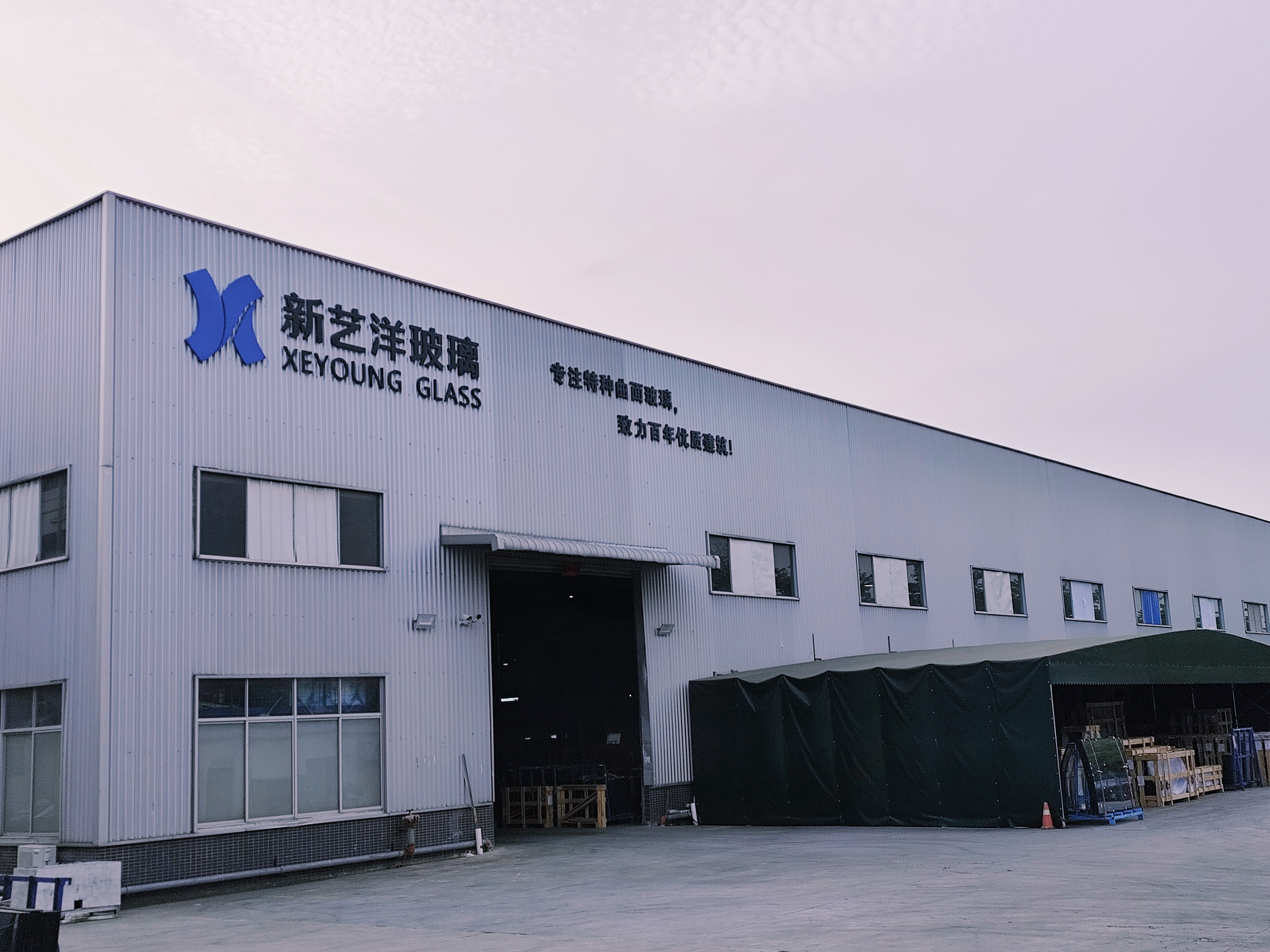
Request a quotation, sample or catalogue for DY-ZK01
Send a true-shape drawing, the required build and the project location to info@dayangglass.com, or message WhatsApp +86 136 9211 0212. The reply covers the build recommendation, the CE documentation package where applicable, and a production schedule. The full product catalogue is available as a downloadable PDF brochure, and the wider product range is on www.dayangglass.com.
Have Questions or Need More Details?
Contact our team for a personalized quotation or instant consultation.
Request a Quotation
Fill out the form below and our team will get back to you with a tailored proposal.
WhatsApp Direct Chat
Prefer to chat in real-time? Message us on WhatsApp for instant assistance & quick answers.
- Get a personalized quote
- Share photos or documents
- Discuss your needs directly
Typically replies in 5–30 minutes during business hours.