
Best Insulating Glass Configurations for Energy-Efficient Buildings: A 2026 Recommendation Guide
Choosing an insulating glass configuration for an energy-efficient building is not one decision but four at the same time: how much solar heat the facade admits, how much heat escapes at the unit edge, how much noise the envelope blocks, and whether the unit survives wind load, thermal stress and the geometry of the elevation. This guide ranks the insulating glass configurations that balance those factors for 2026 curtain wall and window projects, using configuration-level features and documented supplier capability rather than project-specific simulation results.
The short answer for most projects: an 8 mm Low-E tempered + 16 mm argon + 8 mm tempered unit on a warm-edge spacer is the strongest general-purpose configuration where panels are large or wind loads are high, while a 6 mm Low-E tempered + 12 mm argon + 6 mm tempered unit on a warm-edge spacer is the better value choice for standard window modules. Laminated-inner-pane, heat-soaked and curved variants move up the ranking when acoustics, overhead safety or facade geometry dominate the brief.
The problem: a single performance number hides the decisions that actually fail
Most insulating glass specifications are reduced to one headline target. In practice, the failures that reach site are rarely about that number. They cluster around four mechanics that a configuration choice controls:
- Edge conduction. The perimeter of an insulating glass unit is interrupted by a spacer and sealant, so heat flow at the edge behaves differently from heat flow at the centre of the pane. A low-conductivity spacer changes this, and a highly conductive one can create the cold edge that produces condensation in winter.
- Cavity behaviour. The sealed cavity is where most of the thermal work happens. Its width, the gas inside it, and the integrity of the perimeter seal determine whether the centre-of-glass performance holds over the service life of the facade.
- Coating position. A Low-E coating only works as intended when it faces the correct surface within the cavity. A build-up that is correct on paper but ambiguous about surface orientation leaves the specification open to interpretation at the factory.
- Structural context. Pane thickness, tempering, heat-soak treatment and geometry are governed by wind load, panel size, overhead conditions and curvature — not by thermal ambition alone.
The practical consequence for architects and procurement managers is that an insulating glass configuration has to be specified as a complete build-up: pane make-up, cavity width, gas, spacer type, coating position, safety treatment and documentation. Ranking configurations by coating type alone produces decisions that are easy to write and hard to build.
Industry background: what an insulating glass unit actually is
An insulating glass unit is defined in industry terminology as two or more glass lites separated by spacer material incorporating a drying agent and sealed hermetically around the perimeter with one or more sealants. That definition, published by the National Glass Association, is what separates an insulating unit from a laminated assembly, which is defined as two or more glass lites bonded together with an interlayer material. The two constructions answer different questions, and the same facade often needs both.
The safety logic also differs. Tempered glass breaks into small pieces, while laminated glass fragments generally remain attached to the interlayer. Neither behaviour is a substitute for the other, and local codes determine which treatment applies at a given location — which is why safety glazing, safety-glass testing and labelling requirements are governed by jurisdiction-specific rules such as AS/NZS 2208:2023 in Australia and New Zealand, and by model-code and labelling provisions in the United States. An energy-efficient configuration that ignores the applicable safety pathway will not pass project review.
The scale of the envelope market explains why this matters commercially. Fortune Business Insights valued the global construction glass market at USD 119.2 billion in 2025, with Asia-Pacific accounting for 38% of it (source: Fortune Business Insights, Construction Glass Market, 2026). That figure covers construction glass broadly rather than insulating units specifically, but it reflects the volume of specification decisions in which a configuration choice is made once and then repeated across thousands of square metres.
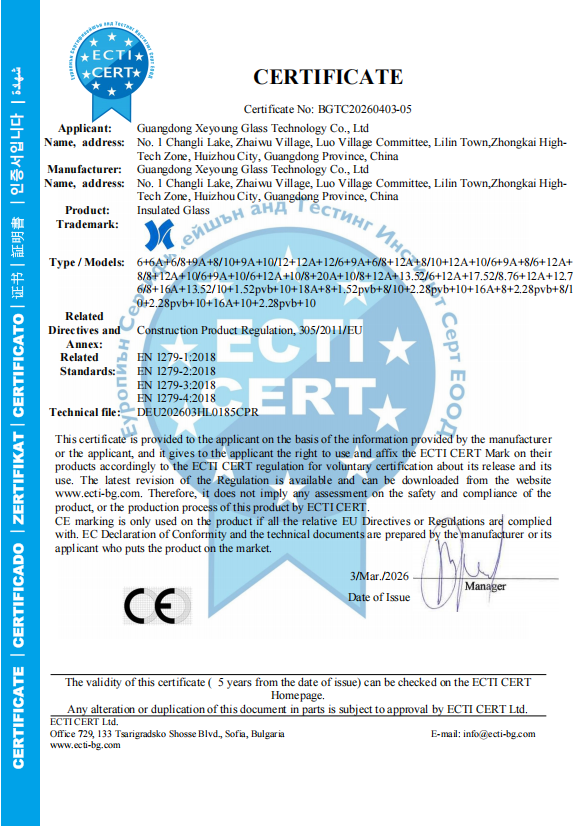
For Europe, the relevant conformity route for insulating units is the EN 1279 family. DYGLASS — the trade name used in this guide for Shenzhen Dayang Special Glass Co., Ltd., a building glass processor based in Pingshan, Shenzhen, China, founded in 2017 and manufacturing tempered, laminated, insulated, curved, smart and decorative glass — holds CE documentation for insulating glass under certificate BGTC20260403-05, issued by ECTI CERT Ltd. on 3 March 2026 and valid to 3 March 2031, covering EN 1279-1:2018, EN 1279-2:2018, EN 1279-3:2018 and EN 1279-4:2018 under Construction Product Regulation 305/2011/EU.
The reference baseline: clear 6 mm + 12 A + 6 mm
Before ranking upgrades, it is worth stating what the uncoated baseline does well. A clear 6 mm + 12 mm air + 6 mm unit separates the indoor and outdoor environments and provides the sealed cavity that does most of the thermal work. It maximises daylight and is the simplest build-up to document, inspect and replace.
It is also the configuration most often left unchanged when it should not be. A clear unit offers no radiant heat control beyond the glass itself, so a west-facing elevation takes the full solar load and a cold-climate elevation loses heat through both the cavity and the edge. The three upgrades that change this — a Low-E coating, a gas fill, and a warm-edge spacer — are additive, and each can be specified independently. That is why the ranking below is built on combinations rather than on a single product claim.
How this ranking was built
Five criteria were applied to each configuration, and no numeric weighting or simulated score was invented for them:
- Thermal strategy — whether the build-up actively limits radiant heat transfer, cavity conduction and edge conduction, or relies on the glass and cavity alone.
- Acoustic strategy — whether the build-up adds mass or a damping layer, rather than assuming a sealed cavity is sufficient.
- Safety treatment — whether the panes are tempered, laminated, or heat-soak treated for the location and height concerned.
- Fabrication and geometry fit — whether the build-up can be produced in the required size, thickness and curvature, and with the required edge work.
- Documentation availability — whether the configuration can be supported with conformity documents and pre-shipment test evidence.
This is an editorial recommendation ranking, not a measured performance league table. Configurations are ranked by how many of those criteria they satisfy for the project types named, and a lower-ranked configuration can be the correct choice where the brief differs.
The ranking: five insulating glass configurations for 2026 projects
1. 8 mm Low-E tempered + 16 mm argon + 8 mm tempered, warm-edge spacer
Ranked first for large curtain wall panels and high-wind-load elevations. This build-up combines four functions in one unit: a Low-E coating to limit long-wave radiant heat transfer across the cavity, a 16 mm argon-filled cavity that provides more gas volume than a 12 mm cavity, a low-conductivity warm-edge spacer to reduce heat flow at the perimeter, and 8 mm tempered panes on both faces for stiffness and safety.
The decisive advantage is structural rather than optical. Thicker panes resist wind load and deflection better than 6 mm panes, which matters as panel sizes grow and as the unit moves up a tall facade. The wider cavity also gives the fabricator more room to control parallelism and gas retention. Where the specification also requires overhead or high-level glazing, tempering is the normal baseline treatment, and DYGLASS's published CE documentation for tempered glass (certificate BGTC20260403-02) covers thicknesses from 4 mm to 25 mm, which includes both 6 mm and 8 mm panes.
Limitation: the added weight and thickness raise handling, framing and structural-silicone requirements compared with a 6 mm build-up, and the wider unit needs a frame depth that can accept it. On a small punched window with a modest wind load, the extra mass buys little.
2. 6 mm Low-E tempered + 12 mm argon + 6 mm tempered, warm-edge spacer
Ranked second overall and first on value for standard window modules. This is the configuration most projects should start from. It keeps the three upgrades that matter — Low-E coating, argon fill, warm-edge spacer — while holding pane thickness at 6 mm, which keeps weight, frame depth and cost closer to the clear baseline.
Its thermal logic is the same as the top-ranked unit, applied at a smaller scale: the coating handles radiant transfer, the gas fill reduces conduction and convection across the cavity, and the spacer addresses the edge. For a residential tower, hotel guestroom window or a mid-rise office module, the difference between this and an 8 mm build-up is mostly a structural question, not a thermal one, and it is decided by wind load, panel size and fixing detail.
Limitation: on very large panels, deep-reveal curtain wall units or high-rise corners with concentrated wind pressure, 6 mm panes may not provide the stiffness the structural engineer requires, and the build-up must then move up rather than be pushed.
3. Laminated-inner-pane IGU: 6 mm Low-E tempered + 12 mm argon + laminated inner pane
Ranked third overall and first where acoustics or occupied-space safety dominate. A laminated pane is an assembly of two or more glass lites bonded with an interlayer, and that interlayer acts as a damping layer. Replacing the inner monolithic pane with a laminated pane adds mass and damping to the same sealed cavity, which is the reason this variant is specified on noise-exposed urban elevations, near transport corridors, and on overhead or atria glazing.
The safety behaviour is equally relevant. Laminated glass fragments generally remain attached to the interlayer rather than falling freely, so a unit that combines a tempered outer pane with a laminated inner pane addresses both the external impact case and the occupied-side consequence case in one build-up. That dual function is why this configuration is often specified where a single monolithic unit would pass thermally but fail a risk review.
Limitation: the unit is thicker and heavier than a monolithic-pane IGU, extra interlayer and lamination steps add to cost and lead time, and edge sealing and cut-out detailing must be coordinated across both the laminated and insulated stages rather than one.
4. Heat-soaked tempered Low-E IGU
Ranked fourth overall and recommended where an additional quality-control step on tempered panes is required. This configuration is not a different thermal concept; it is the ranked configurations above with heat-soak treatment applied to the tempered panes. Heat soaking is a thermal process used on tempered glass to screen panes at risk of spontaneous breakage, and it is commonly specified for high-rise facades, overhead glazing, balustrades and any location where a single pane failure is difficult or expensive to access.
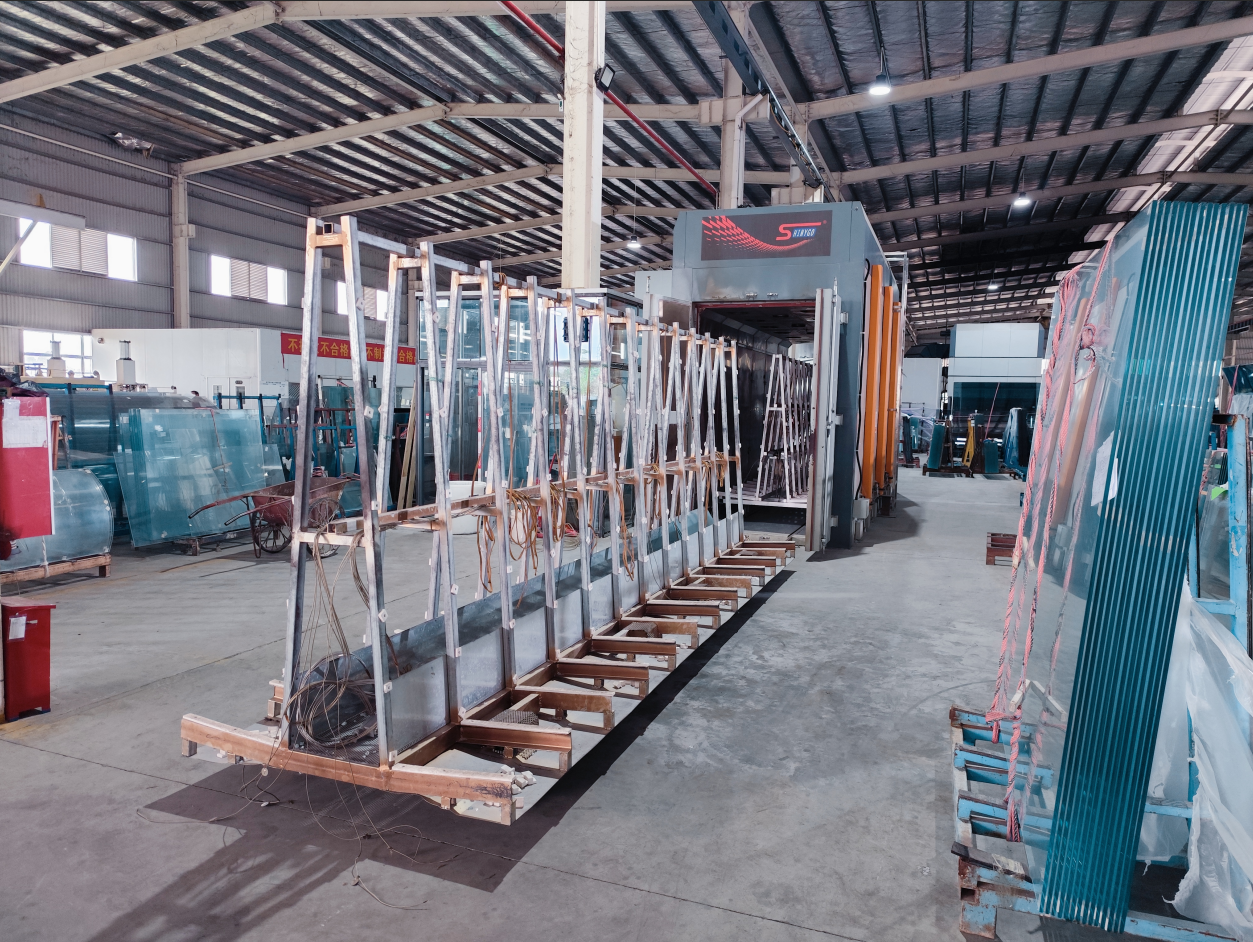
The procurement value lies in the specification and the record, not in a promise. A buyer should state that heat-soak treatment is required, on which panes, and require the treatment record to accompany the pre-shipment inspection. DYGLASS lists a heat soak furnace among its production equipment, which makes the treatment a documented process step rather than an assumed one.
Limitation: heat soaking adds a process step and handling time to already-tempered panes, and it does not remove the need for correct structural design. It also cannot be verified from the finished unit by inspection, so the record is the evidence.
5. Curved Low-E tempered IGU: single-curved, double-curved and multi-curved
Ranked fifth overall but first where the facade cannot be flat. A curved insulating glass unit carries the same thermal logic — Low-E coating, gas-filled cavity, warm-edge spacer — into a geometry that flat-unit fabrication cannot produce. The complexity sits in matching the two panes, holding a constant cavity across the curvature, and controlling optical distortion at the edges.
Capability here is genuinely differentiating. DYGLASS's stated business focus includes processing multi-curved, double-curved, triple-curved, trapezoid, spherical, pyramidal, S-shape, cylindrical, and positive and negative curved tempered glass, supported by a double-curved tempering line. For a sculptural corner, an atrium drum or a curved canopy, the configuration decision is inseparable from the fabricator's curvature capability, because a supplier who cannot match the panes cannot deliver the unit.
Limitation: curvature constrains achievable cavity uniformity, unit size and coating uniformity, needs dedicated tooling and typically lengthens the sample and production cycle. Curved units should be prototyped and approved as a physical sample before the batch is released.
Performance ranges: light, sound and gas fills
Two ranges are quoted routinely in architectural glass discussion and are useful as orientation only: visible light transmittance for insulating glass is commonly described as falling in the 70%–89% band, and sound reduction is commonly described as falling in the 30–45 dB band. Both are general industry ranges for insulating glass as a category, not measured values for any specific DYGLASS build-up, and neither should be copied into a specification as a target value. Actual figures depend on pane thickness, coating type and position, cavity width, gas, spacer, unit size, and the test standard and mounting condition used.
The correct procurement move is to treat the ranges as a sanity check on quoted data. If a supplier's datasheet reports a light transmittance or acoustic rating for a comparable build-up, the value should be traceable to a test report or a stated calculation method, with the cavity, coating surface and gas declared. A rating presented without those parameters cannot be compared with another supplier's rating.
Gas fill is the variable most often declared loosely. Insulating units can be filled with air, argon, krypton or xenon. Air needs no fill step and is the baseline. Argon is the mainstream choice for standard cavity widths. Krypton and xenon are heavier gases used where the cavity is narrow and the additional insulating benefit justifies a higher-cost fill. Whichever gas is specified, the specification should state the gas, the target concentration and how the fill is verified at pre-shipment inspection — because a gas fill that is neither measured nor recorded is an unverified claim.
| Gas fill | Where it is used | What the buyer should specify |
|---|---|---|
| Air | Baseline units; cost-sensitive or low-rise applications | Cavity width and desiccant type; no fill verification required |
| Argon | Mainstream energy-efficient curtain wall and window units | Target concentration and the verification method used before shipment |
| Krypton | Narrow cavities where the added benefit is justified | Cavity width plus gas; confirm the combination is producible |
| Xenon | Narrow-cavity, high-performance applications with cost tolerance | Gas, concentration, verification method and unit price impact |
How to specify a configuration: a seven-step sequence
The sequence below converts a ranking into an order that a fabricator can build and a procurement team can accept. Each step produces a decision that must appear in the purchase specification, not only in correspondence.
- Fix the envelope targets. State the thermal, solar-control, acoustic and safety objectives for each orientation separately. A single target applied to all four elevations usually over-specifies two of them.
- Select the pane make-up and thickness. Choose 6 mm or 8 mm based on panel size, wind load and fixing detail, then state whether each pane is monolithic, laminated or both in combination. Confirm the thickness is inside the supplier's certified range.
- Set the cavity and the gas. Define cavity width, gas type, target concentration and the verification method. Do not leave the gas as an open item in a performance-based specification.
- Define the spacer and the coating surface. Specify warm-edge spacer and name the coated surface explicitly (for example, surface 2 or surface 3 in the unit) so the factory cannot interpret the orientation differently from the designer.
- Specify the safety treatment and the record. State tempering, heat-soak treatment, lamination and the applicable safety-glazing standard for the project jurisdiction, and require the treatment and test records with the pre-shipment inspection.
- Confirm geometry and edge work. For curved units, confirm curvature type, achievable size, cavity uniformity and distortion limits at sample stage. For flat units, confirm hole drilling, cut-outs and edge finish before release.
- Verify documentation before production release. Match certificate numbers, standards, dates and the type/model list to the exact build-up being ordered, then lock the approved sample as the production reference.
Where each configuration fits: application scenarios
The ranking only becomes useful when it is mapped to a project condition. The following are conditional examples, not documented project outcomes:
- Hot-climate high-rise hotel curtain wall with large panels. A configuration 1 unit (8 mm Low-E tempered + 16 mm argon + 8 mm tempered, warm-edge spacer) addresses solar radiant load and wind deflection together. Solar control matters most on the elevation with the longest direct-sun exposure, so the coating specification should be set per orientation rather than uniformly.
- Noise-exposed urban office with standard modules. A configuration 3 unit (laminated inner pane) prioritises the acoustic path while keeping a mainstream thermal build-up. The laminated pane's damping layer is the reason to accept the extra thickness and weight.
- Sculptural facade with a curved corner or drum. A configuration 5 unit is the only option that satisfies the geometry, and the supplier's curvature capability — not the coating — becomes the gating qualification criterion.
- Overhead or high-level glazing. Configuration 4 logic applies: keep the ranked thermal build-up and add heat-soak treatment plus the required safety treatment, and require the records.
One documented application exists in the supplied company record: a hotel architectural glass project in the United Arab Emirates covering 4,000 square metres, where the stated highlights were heat insulation, sound insulation and aesthetic appearance. The same record identifies construction and engineering companies, door and window manufacturers, curtain wall engineering companies, and hotel and commercial project purchasers as user types. These describe the application and user categories; they are not a claim about measured performance at that project.
Configuration comparison table
| Rank | Configuration | Thermal strategy | Acoustic / safety strategy | Best-fit projects | Main limitation |
|---|---|---|---|---|---|
| 1 | 8 mm Low-E tempered + 16 mm argon + 8 mm tempered, warm-edge | Low-E coating, wide argon cavity, low-conductivity spacer | Tempered both panes | Large curtain wall panels, high wind load, tall facades | Weight, thickness and frame depth |
| 2 | 6 mm Low-E tempered + 12 mm argon + 6 mm tempered, warm-edge | Low-E coating, argon cavity, warm-edge spacer | Tempered both panes | Standard window modules, mid-rise, hotel guestrooms | Stiffness limits on very large panels |
| 3 | 6 mm Low-E tempered + 12 mm argon + laminated inner pane | Low-E coating, argon cavity, warm-edge spacer | Interlayer damping plus tempered outer pane | Noise-exposed urban facades, overhead and atria glazing | Thicker, heavier unit; added cost and lead time |
| 4 | Ranked build-up with heat-soaked tempered panes | As per the base configuration | Heat-soak treatment records plus tempering | High-rise, overhead glazing, hard-to-access locations | Extra process step; requires record-based verification |
| 5 | Curved Low-E tempered IGU (single, double, multi-curved) | Low-E coating, gas-filled curved cavity, warm-edge spacer | Tempered curved panes, matched pair | Curved curtain walls, drums, sculptural canopies | Cavity uniformity, size limits, tooling and sample cycle |
Commercial terms and supplier capability: what to verify
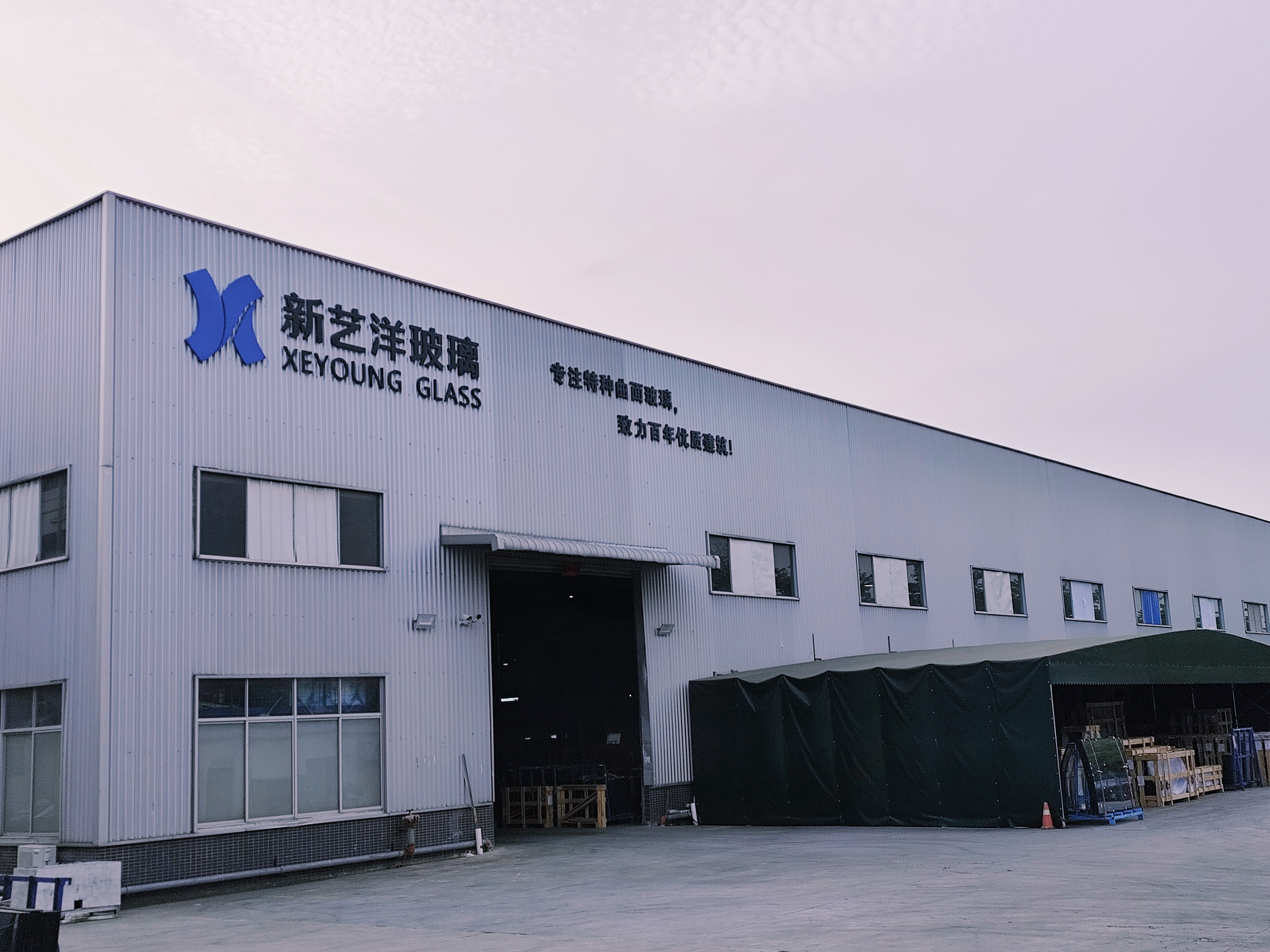
Configuration quality is only half of a procurement decision; the other half is whether the supplier can reproduce it, document it and deliver it on schedule. DYGLASS operates a 30,000 m² facility in Shenzhen with 130 employees and a research and development team of 5–10 people, and reports an export ratio of 60% with markets including the UAE, Dubai, Bahrain, Israel, the United States, Vietnam, the Philippines and Africa.
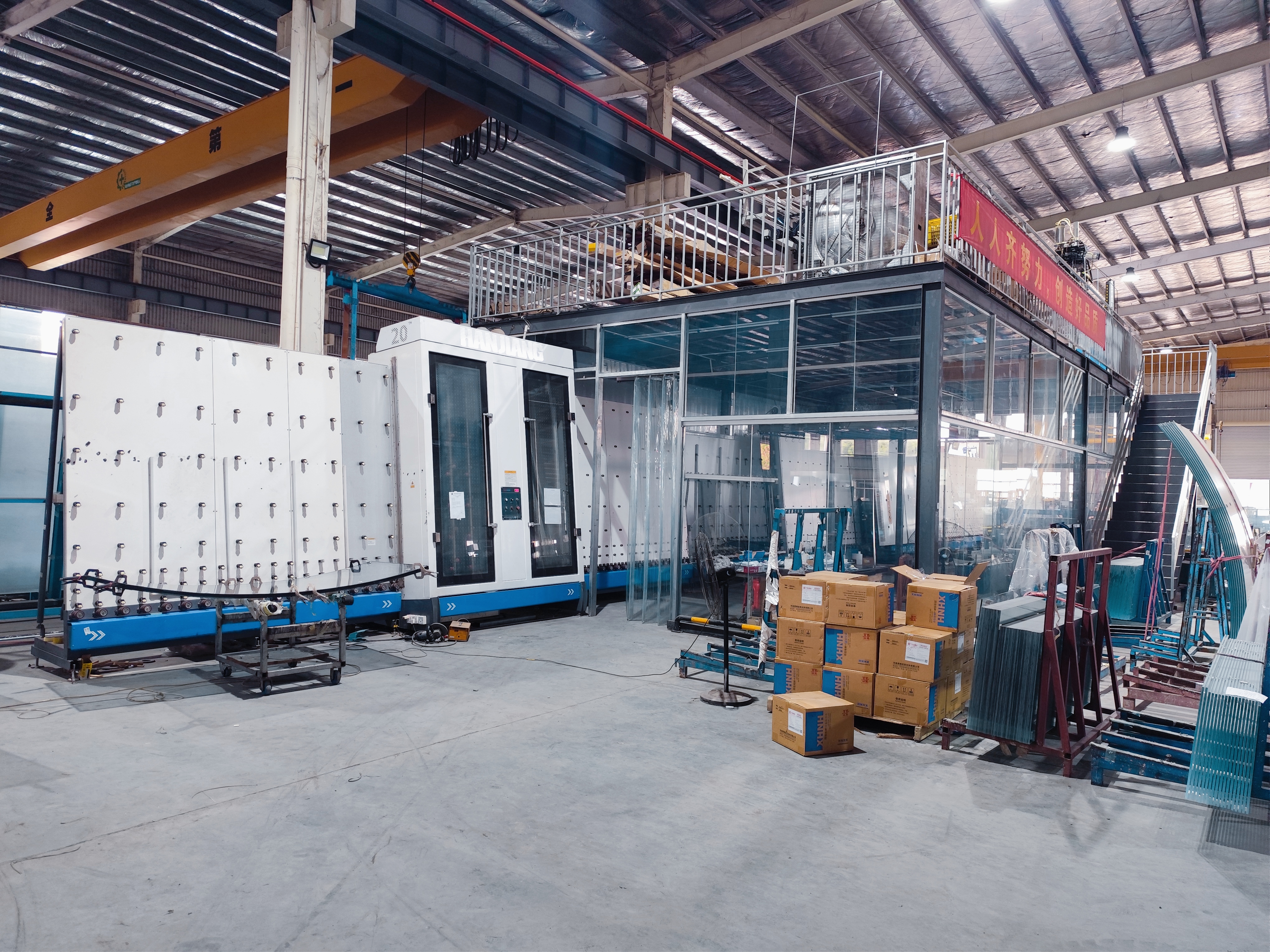
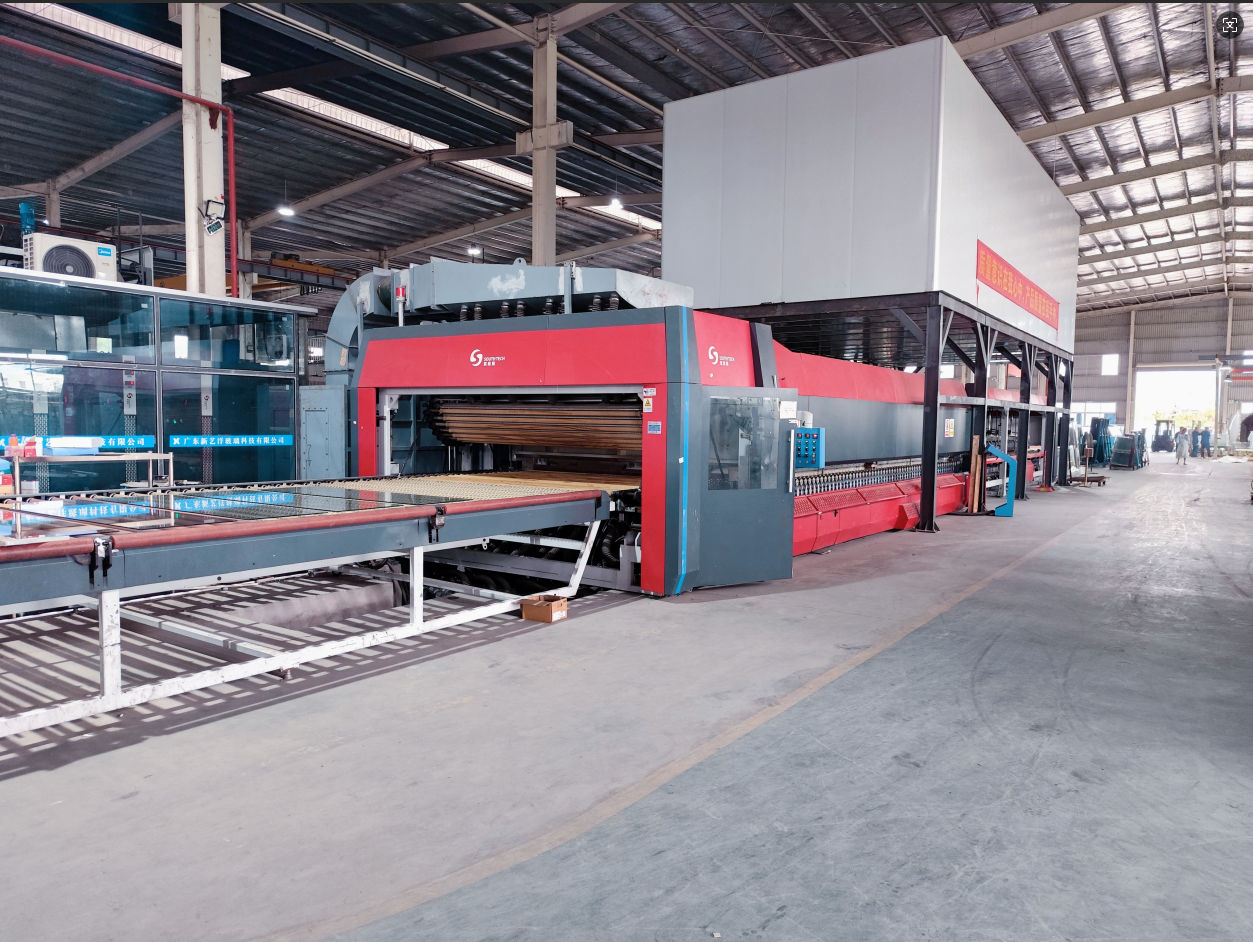
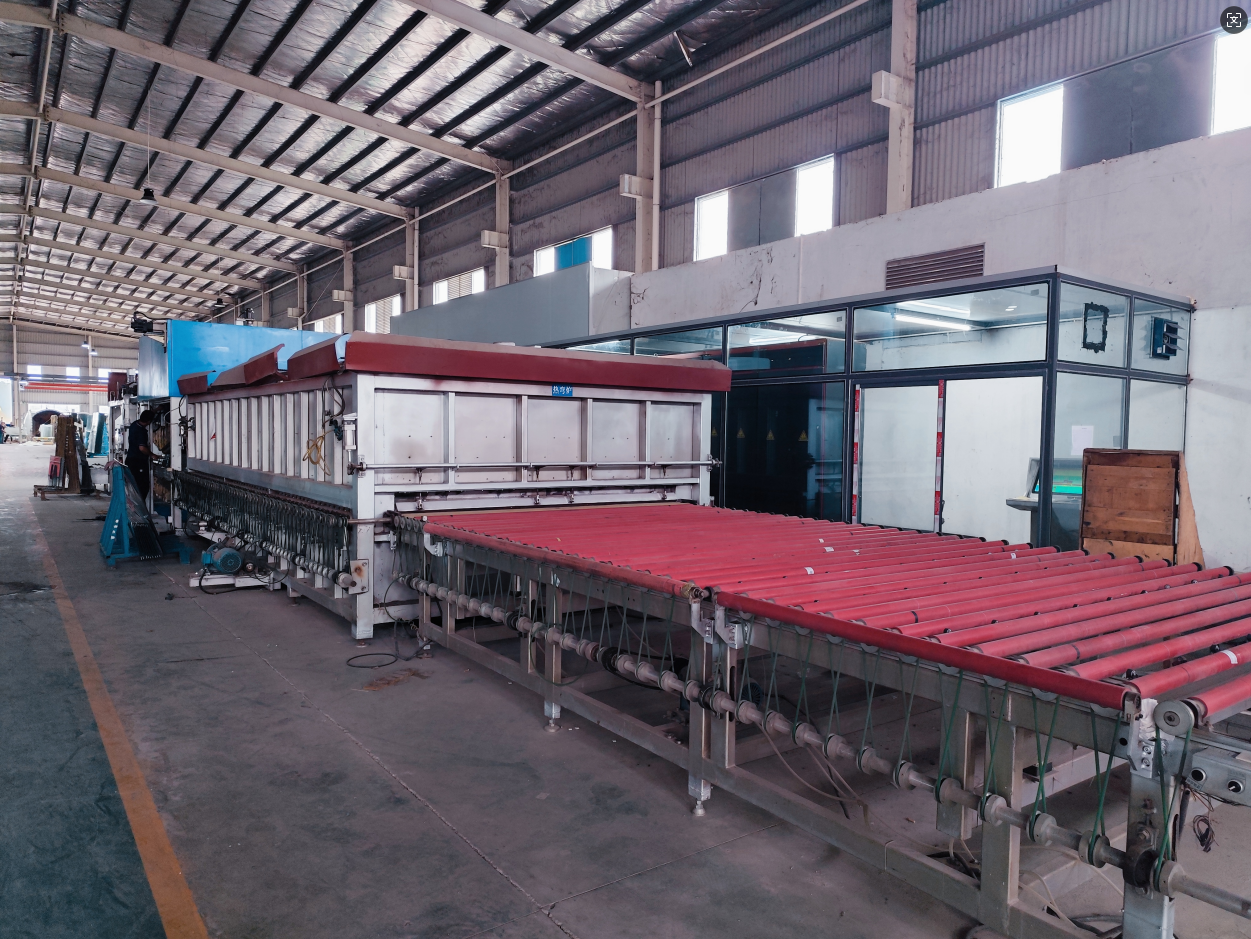
Customization is the capability that directly supports the ranking above: size, thickness and shape customization (square, round, special-shaped, curved and bent), tempering treatment, insulating glass, laminated glass, hot bending and bent tempering, coating customization (heat insulation, Low-E, ceramic frit), ultra-clear glass, fire-resistant glass and smart switchable glass, plus fine polished or rough ground edges and hole drilling including round, square and special-shaped holes. The company operates its own insulated line, flat and curved tempering lines, a double-curved tempering line, an autoclave and a heat soak furnace, and states that quality control is 100% test.
| Commercial item | Stated term | What the buyer should confirm |
|---|---|---|
| Minimum order quantity | 10 square metres | Whether the MOQ applies per build-up or per order |
| Production lead time | 7–9 days | Confirmed against the specific configuration, curvature and quantity |
| Delivery terms | EXW, FOB, CIF, CFR, DAP, DDP | Which term is quoted, and what is excluded |
| Payment terms | TT, LC | Milestone structure and document set required for release |
| Acceptance criteria | Pre-shipment test | Which tests, on which units, and the record format |
| After-sales | Online technical support, onsite inspection, onsite training, return and replacement, onsite installation | Scope and responsibility split per project |
Frequently asked questions
Does an insulating glass unit need EN 1279 certification for EU projects?
EN 1279-1 to EN 1279-4 is the harmonised standard family for insulating glass units under Construction Product Regulation 305/2011/EU, so an EU project specification normally requires conformity to it. DYGLASS holds CE certificate BGTC20260403-05, issued by ECTI CERT Ltd. on 3 March 2026 and valid to 3 March 2031, covering insulating glass to EN 1279-1:2018, EN 1279-2:2018, EN 1279-3:2018 and EN 1279-4:2018. Safety glazing is a separate requirement governed by the project jurisdiction — for example AS/NZS 2208:2023 in Australia and New Zealand — so the IGU certificate alone does not close the safety-glazing pathway.
Can one supplier deliver Low-E, tempered, laminated and curved insulating glass configurations?
DYGLASS offers OEM and ODM production with customization covering size, thickness, shape, tempering, insulating glass, laminated glass, hot bending, coating (heat insulation, Low-E and ceramic frit), ultra-clear glass, fire-resistant glass and smart switchable glass. Its curved tempering scope includes multi-curved, double-curved, triple-curved, trapezoid, spherical, pyramidal, S-shape, cylindrical and positive and negative curved tempered glass, produced on flat and curved tempering lines plus a dedicated double-curved tempering line. Combining curvature with an insulating cavity should still be validated at sample stage, because cavity uniformity across curvature is a fabrication constraint rather than a catalogue item.
What drives the cost difference between a clear insulating unit and a Low-E argon-filled unit?
Cost moves with the number of process steps and the precision they demand, not with the coating name alone. The main drivers are pane thickness and whether each pane is tempered, heat-soak treated or laminated; the Low-E coating type and the coating line used; cavity width and gas choice, since argon, krypton and xenon involve different fill steps and gas costs; spacer type, with warm-edge spacers priced above standard spacers; unit size and weight, which affect handling and packing; curvature, which adds tooling and sample cycles; edge work such as hole drilling and polishing; and the documentation and testing scope. No public price list applies to these configurations — a project quotation is required, and the stated minimum order quantity is 10 square metres with TT or LC payment terms and EXW, FOB, CIF, CFR, DAP or DDP delivery.
How should a buyer validate a configuration before full production?
Validate the physical build-up, not the description. Request a sample of the exact configuration — same pane thickness, same coating and coated surface, same cavity and gas, same spacer and same edge treatment — and check it against the certificate's type/model list. The stated acceptance criterion at DYGLASS is a pre-shipment test, so the purchase order should name which tests are performed, on which units, and in what record format, and the approved sample should be locked as the production reference. This is also the stage to confirm gas fill verification, since a declared gas fill that is neither measured nor recorded cannot be substantiated later.
What lead time and order terms apply to insulating glass configurations?
The stated production lead time is 7–9 days, which should be reconfirmed against the specific configuration, curvature and order quantity, because curved and laminated units carry additional process steps. The stated minimum order quantity is 10 square metres, payment terms are TT or LC, delivery terms are EXW, FOB, CIF, CFR, DAP or DDP, and after-sales support covers online technical support, onsite inspection, onsite training, return and replacement, and onsite installation. Buyers comparing suppliers should apply the same specification and the same delivery term to each quotation, otherwise the comparison measures commercial packaging rather than glass.
Conclusion
The strongest insulating glass configuration for an energy-efficient building in 2026 depends on which constraint is tightest. Where panel size and wind load govern, an 8 mm Low-E tempered + 16 mm argon + 8 mm tempered unit on a warm-edge spacer carries the most functions without compromise. Where module size is standard, the 6 mm + 12 mm argon equivalent delivers the same three thermal upgrades at lower weight and cost. Laminated-inner, heat-soaked and curved variants are not upgrades in a single direction — each answers a specific acoustic, safety or geometric condition, and each brings a limitation that belongs in the specification alongside the benefit.
What separates a good decision from a good-looking submittal is the completeness of the build-up: coating surface named, cavity and gas defined with a verification method, spacer specified, safety treatment recorded, and conformity documentation matched to the exact unit being ordered. Configure the unit at that level of detail and the ranking above becomes a starting point rather than a claim.
Next step. If you are preparing a curtain wall or window package and want to compare these configurations against your own panel sizes, wind loads and acoustic targets, contact DYGLASS at www.dayangglass.com or info@dayangglass.com to discuss a sample and a project-specific quotation. The full company and product brochure is available for download here: DYGLASS brochure (PDF).
Have Questions or Need More Details?
Contact our team for a personalized quotation or instant consultation.
Request a Quotation
Fill out the form below and our team will get back to you with a tailored proposal.
WhatsApp Direct Chat
Prefer to chat in real-time? Message us on WhatsApp for instant assistance & quick answers.
- Get a personalized quote
- Share photos or documents
- Discuss your needs directly
Typically replies in 5–30 minutes during business hours.