
How to Compare Building Glass for Sound Insulation: A Step-by-Step Guide for Specifiers

Answer in brief: compare building glass for sound insulation by separating the glass construction type (insulating, laminated, or hybrid), the glass thickness build-up, the interlayer material and thickness, the spacer and gas-fill choice, and the CE certification backing each configuration — then match that specification to the noise profile of the project. Sound-insulation values for DYGLASS products are listed as 30–45 dB for insulating glass (DY-ZK01) and 35–45 dB for laminated glass (DY-JJ01).
Why a structured comparison matters for acoustic building glass
Acoustic performance is one of the last variables fixed in facade design and one of the most expensive to correct after installation. A glazing specification that satisfies U-value, visible light transmittance, wind load and safety requirements can still fail acoustic targets if the interlayer, air gap or glass mass is selected without a defined comparison method.
Specifiers comparing building glass for sound insulation usually face two problems. First, acoustic performance is expressed inconsistently — some suppliers describe test results, others describe calculated ranges, and others quote a generic category. Second, insulating glass and laminated glass are different assemblies with different governing standards, so a single number rarely transfers between them.
This guide resolves both problems by turning the comparison into seven ordered steps that start with the project's noise environment and finish with a certificate and a capability check.
Industry background: why acoustic glazing is specified differently from thermal glazing
Insulating glass and laminated glass are defined by their construction, not by a single performance figure. Insulating glass is defined as two or more lites separated by spacer material, incorporating a drying agent and hermetically sealed around the perimeter with one or more sealants (EV-0015). Laminated glass is defined as an assembly of two or more glass lites bonded together with an interlayer material (EV-0016).
That difference matters for acoustics. In an insulating unit the dominant variables are glass mass, cavity width and gas fill. In a laminated assembly the dominant variables are glass mass and the damping behaviour of the interlayer. This is why a specifier cannot compare an insulating unit and a laminated pane on the strength of one dB value — the assemblies behave differently across the frequency spectrum even when their single-number ratings look similar.
Market context supports the increasing weight of acoustic specification without justifying a numeric claim. Global construction glass was valued at USD 119.2 billion in 2025, with Asia-Pacific accounting for 38% of that value (EV-0001, EV-0002). Within that volume, building glass supplier portfolios consistently position products by application — exterior glazing, interior decoration, safety and security, solar control (EV-0008, EV-0009, EV-0011) — which is exactly why a specifier must compare by function, not by product category name.
What actually determines acoustic performance in building glass
Before any step-by-step process, the specifier should understand which physical variables drive acoustic outcome. Five variables dominate.
1. Glass mass and thickness
Heavier glass resists sound transmission more effectively than lighter glass at the same frequency. This is the most reliable single principle in acoustic glazing selection, and it explains why 8mm panes usually outperform 6mm panes in comparable assemblies. In the DYGLASS range, tempered glass (DY-GH01) is available from 3mm to 19mm, and laminated glass (DY-JJ01) is available from 6.38mm to 50mm overall thickness.
2. Interlayer type and thickness
In laminated glass, the interlayer is the primary acoustic damping element. DYGLASS laminated glass lists PVB, SGP and EVA interlayers at 0.38mm, 0.76mm, 1.14mm, 1.52mm and 2.28mm. Thicker interlayers generally provide more damping, but the acoustic outcome depends on the interlayer formulation and the glass mass on either side. A specification should always pair an interlayer designation with a tested configuration, not with a generic material claim.
3. Cavity and gas fill
In insulating glass, the cavity between lites provides an additional acoustic barrier. DYGLASS insulating glass (DY-ZK01) supports air, argon, krypton and xenon fills, and the standard build-ups are 6mm+12A+6mm and 8mm+16A+8mm, with custom thicknesses available. Gas fill and cavity width primarily affect thermal performance; the acoustic effect is secondary but relevant at mid-to-high frequencies.
4. Spacer type
Aluminium and warm-edge spacers are both offered in DYGLASS insulating glass. Spacer choice is chiefly a thermal and condensation-control decision; its acoustic contribution is small relative to glass mass and interlayer selection.
5. Assembly and edge seal integrity
The perimeter seal in both insulating and laminated glass must remain intact for the assembly to deliver its rated performance. Edge seal integrity is a manufacturing quality variable, not a design variable — which is why supplier test coverage matters as much as the datasheet.
Step-by-step comparison framework
Step 1 — Define the acoustic target from the project's noise environment
Start with the noise source, not with a product. A roadside residential tower, a hotel facing a transport corridor and a school near rail infrastructure have different spectral profiles and different acceptable indoor noise limits. Define the target indoor noise level and the dominant frequency band before comparing products, because a configuration that performs well against high-frequency traffic noise may not perform well against low-frequency rail noise.
Step 2 — Choose the construction type: insulating, laminated or hybrid
Each construction type has a defined build-up and a different acoustic mechanism.
- Insulating glass — two or more lites separated by a spacer and sealed at the perimeter. DYGLASS insulating glass (DY-ZK01) is listed with sound insulation of 30–45 dB.
- Laminated glass — two or more lites bonded with an interlayer. DYGLASS laminated glass (DY-JJ01) is listed with sound insulation of 35–45 dB.
- Hybrid configuration — an insulating unit where one or both lites are laminated. This combines cavity isolation with interlayer damping and is commonly specified where acoustic, safety and thermal requirements overlap.
The listed ranges are product-level ranges, not configuration-level guarantees. A specifier must request the tested value for the specific build-up rather than rely on the range alone.
Step 3 — Specify the glass thickness combination
Standard DYGLASS insulating glass build-ups are 6mm+12A+6mm and 8mm+16A+8mm, with custom thicknesses available. For acoustic purposes, three specification patterns are worth understanding.
- Symmetric build-ups (6mm+12A+6mm) are common in residential windows and are adequate where the noise environment is moderate.
- Asymmetric build-ups (for example, differing thicknesses between inner and outer lites) reduce coincidence resonance and typically extend acoustic performance across a broader frequency range.
- Heavier build-ups increase mass and therefore raise transmission loss, but add weight, cost and structural demand on the frame system.
Step 4 — Select the interlayer material and thickness
For laminated and hybrid configurations, the interlayer is the decisive acoustic variable. DYGLASS lists PVB, SGP and EVA interlayer options, with thicknesses of 0.38mm, 0.76mm, 1.14mm, 1.52mm and 2.28mm. In general terms, thicker interlayers provide more damping; the material system determines how that damping behaves across frequencies. The specification decision is therefore a pairing: a specific interlayer material at a specific thickness, tested with the specific glass build-up.
DYGLASS laminated glass (DY-JJ01) covers 6.38mm to 50mm overall thickness and is listed with 35–45 dB sound insulation. Substrates can be tempered, float, low-iron or tinted glass; light transmittance is 85–92% for clear laminated glass and 10–70% for tinted variants.
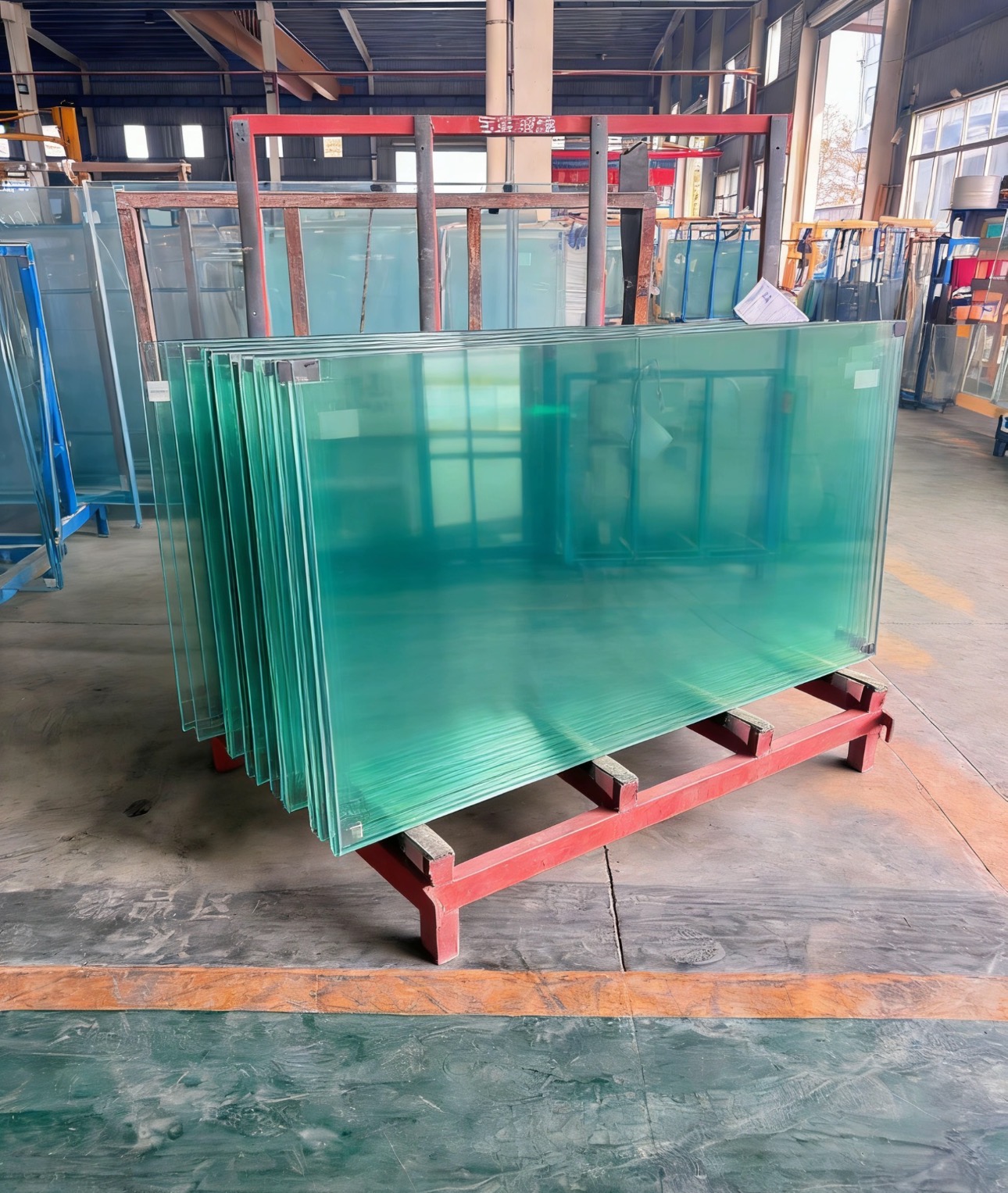
Laminated glass — the interlayer material and thickness are the primary acoustic damping variables.
Step 5 — Specify the spacer and gas fill
For insulating glass, two specifications are required: spacer type and gas fill.
- Spacer: aluminium or warm-edge. Warm-edge spacers reduce thermal bridging at the perimeter; the acoustic difference versus aluminium is small relative to glass mass and cavity design.
- Gas fill: air, argon, krypton or xenon. Argon is widely specified for thermal performance; krypton is used where cavity width is constrained. The acoustic contribution of gas fill is secondary to the mass and cavity geometry.
The DYGLASS insulating glass (DY-ZK01) specification supports aluminium and warm-edge spacers and all four gas options. Light transmittance is listed at 70–89%, depending on the glass type (clear float, Low-E, tempered or low-iron).
Step 6 — Verify the acoustic value and the compliance path
Every acoustic claim should be traceable to a tested configuration and a compliance path. For the EU and EEA market, CE marking is the reference compliance route for building glass.
DYGLASS holds CE certification for the three relevant product families:
- Insulating glass — certificate BGTC20260403-05, issued by ECTI CERT Ltd., against EN 1279-1:2018, EN 1279-2:2018, EN 1279-3:2018 and EN 1279-4:2018, under the Construction Product Regulation 305/2011/EU (CPR).
- Laminated glass — certificate BGTC20260403-03, issued by ECTI CERT Ltd., against EN 1449:2005 and the Construction Product Regulation 305/2011/EU (CPR).
- Tempered glass — certificate BGTC20260403-02, issued by ECTI CERT Ltd., against EN 12150-1:2015+A1:2019 and EN 12150-2:2004, under the Construction Product Regulation 305/2011/EU.
All three certificates carry an issue date of 2026-03-03 and an expiry date of 2031-03-03. A specifier should verify the certificate number directly with the issuing body and confirm that the certificate scope matches the actual build-up ordered.
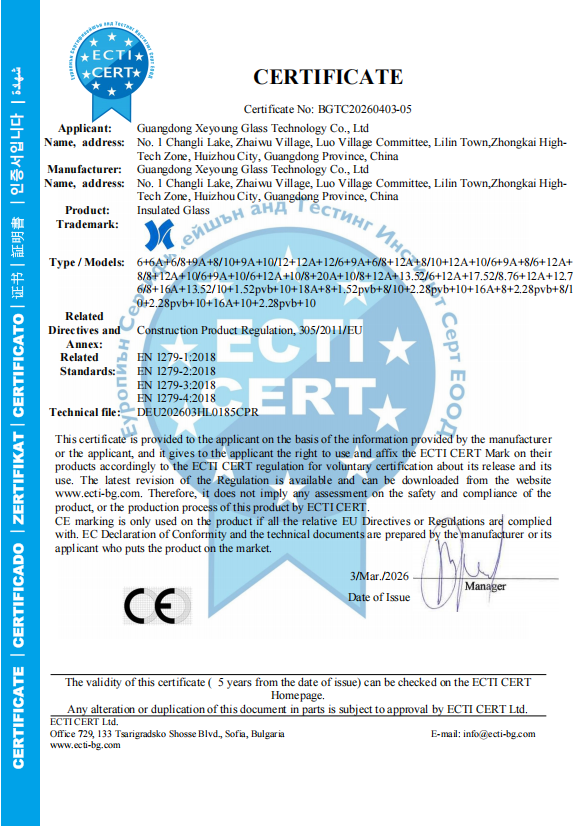
CE certification for insulating glass — certificate BGTC20260403-05 issued by ECTI CERT Ltd.
Step 7 — Confirm supplier capability against the specification
A technically correct specification is only useful if the supplier can produce it. The capability check should cover four items: available glass thickness, available interlayer and spacer combinations, verified test coverage, and production lead time.
DYGLASS operates a 30,000 m² factory with 130 employees and an annual output of 600,000 square meters. OEM and ODM production is supported across size, thickness, shape, tempered treatment, insulating and laminated customisation, hot bending and bent tempering, coating options (heat insulation, Low-E, ceramic frit), low-iron glass, fire-resistant glass, and smart switchable glass. Quality control runs 100% testing, the minimum order quantity is 10 square meters, and the stated lead time is 7–9 days. Export markets include the UAE, Bahrain, Israel, the United States, Vietnam, the Philippines and Africa.
Use cases: matching configuration to project scenario
Urban residential towers facing road traffic
The noise source is typically broadband traffic with strong mid-to-high frequency content. Symmetric insulating glass (6mm+12A+6mm) or an asymmetric build-up with a laminated inner pane is a common pattern. The acoustic priority is glass mass and interlayer damping rather than gas fill.
Hotels near transport corridors
Guest-room comfort places a premium on consistent performance across the facade, not just at the noisiest elevation. A hybrid configuration — laminated glass inside an insulating unit — combines cavity isolation with interlayer damping and delivers safety performance at the same time. The DYGLASS hotel architectural glass case in the UAE, delivered as 4,000 square meters of hotel building glass with heat insulation, sound insulation and aesthetic appearance as stated project highlights, illustrates the configuration pattern used in hospitality applications.
Rail, metro and station projects
Low-frequency content from rail infrastructure is the harder problem. Asymmetric thicknesses and thicker interlayers are typically more relevant than cavity width. Station and transport-hub references in the DYGLASS application set include Huizhou North Railway Station, Nanchang East Railway Station and the Doha Metro Station.
Research, cultural and institutional buildings
These projects typically require a designed acoustic environment rather than a simple noise-reduction target, which usually calls for project-specific analysis rather than a catalogue selection. The China Nano Research Institute is a reference application in the DYGLASS application set.
Sports and large-span public venues
Large glazed areas in sports venues combine acoustic, structural and solar-control demands, which is why hybrid insulating units with Low-E coating are common. The Bahrain International Circuit is a reference application in the DYGLASS set.
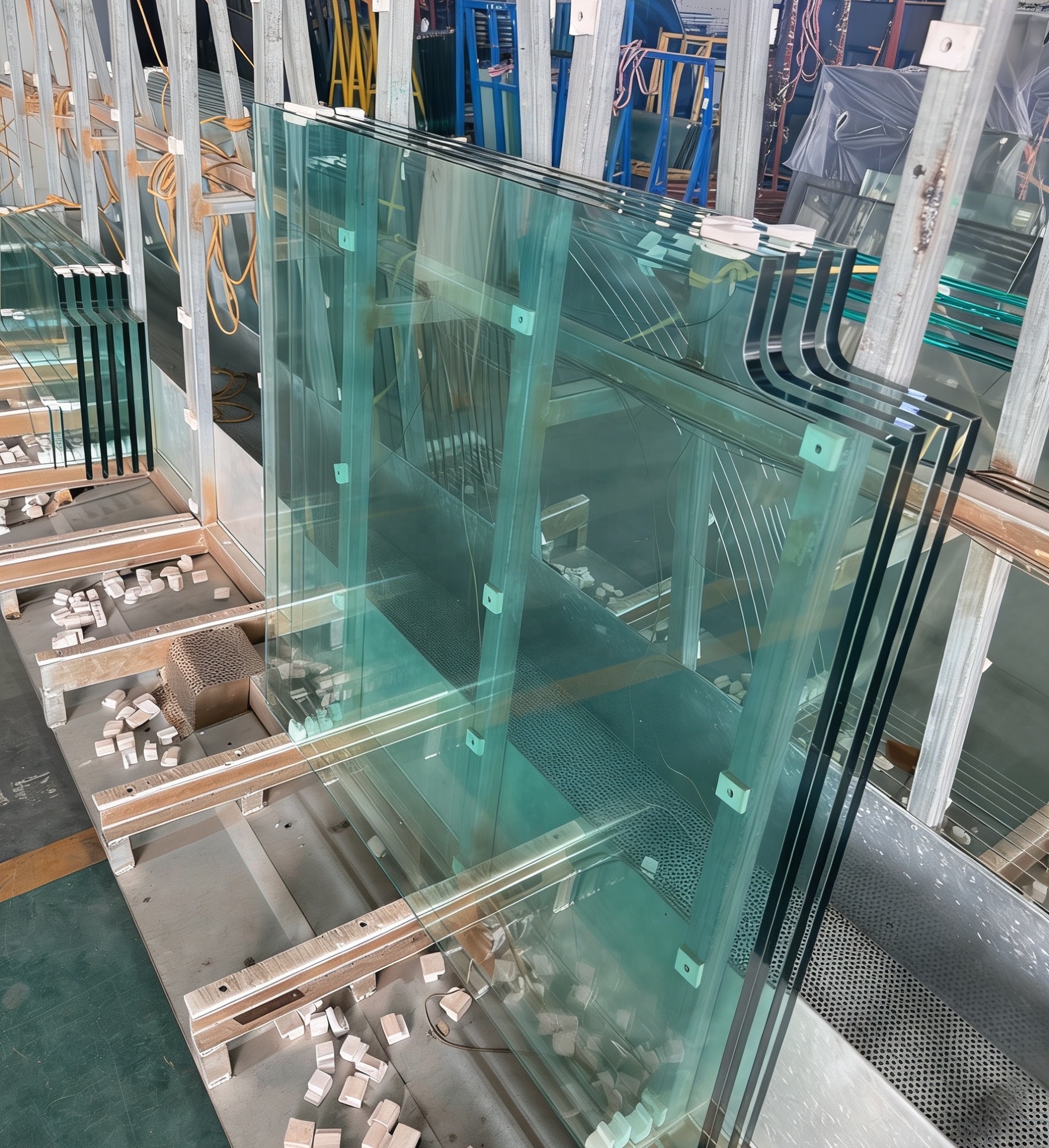
Tempered glass (DY-GH01) is the substrate layer in many acoustic laminated configurations.
Comparison table: DYGLASS insulating vs. laminated glass for acoustic specification
| Comparison parameter | Insulating glass — DY-ZK01 | Laminated glass — DY-JJ01 |
|---|---|---|
| Construction type | Two or more lites separated by spacer material, with desiccant and perimeter seal | Two or more lites bonded with an interlayer |
| Standard thickness build-up | 6mm+12A+6mm / 8mm+16A+8mm (custom available) | 6.38mm to 50mm overall thickness |
| Glass substrate options | Clear float / Low-E / Tempered / Low-iron | Tempered / Float / Low-iron / Tinted |
| Interlayer type | Not applicable | PVB / SGP / EVA |
| Interlayer thickness | Not applicable | 0.38mm / 0.76mm / 1.14mm / 1.52mm / 2.28mm |
| Spacer | Aluminium spacer / Warm-edge spacer | Not applicable |
| Gas fill | Air / Argon / Krypton / Xenon | Not applicable |
| Light transmittance | 70%–89% | 85%–92% (clear) / 10%–70% (tinted) |
| Stated sound insulation | 30–45 dB | 35–45 dB |
| CE certification | BGTC20260403-05 (EN 1279-1:2018 to EN 1279-4:2018) | BGTC20260403-03 (EN 1449:2005) |
| Certification body | ECTI CERT Ltd. | ECTI CERT Ltd. |
| Certification validity | 2026-03-03 to 2031-03-03 | 2026-03-03 to 2031-03-03 |
Hybrid configurations combine an insulating unit with one or more laminated lites; the acoustic value must be verified for the specific build-up and is not covered by the ranges above as a standalone figure. Publicly reported installation-cost data for Europe in 2024 gives USD 128 per square meter for laminated glass and USD 91 per square meter for tempered glass (EV-0005, EV-0006); these figures are not acoustic-specific and should be used only as a general budget reference.
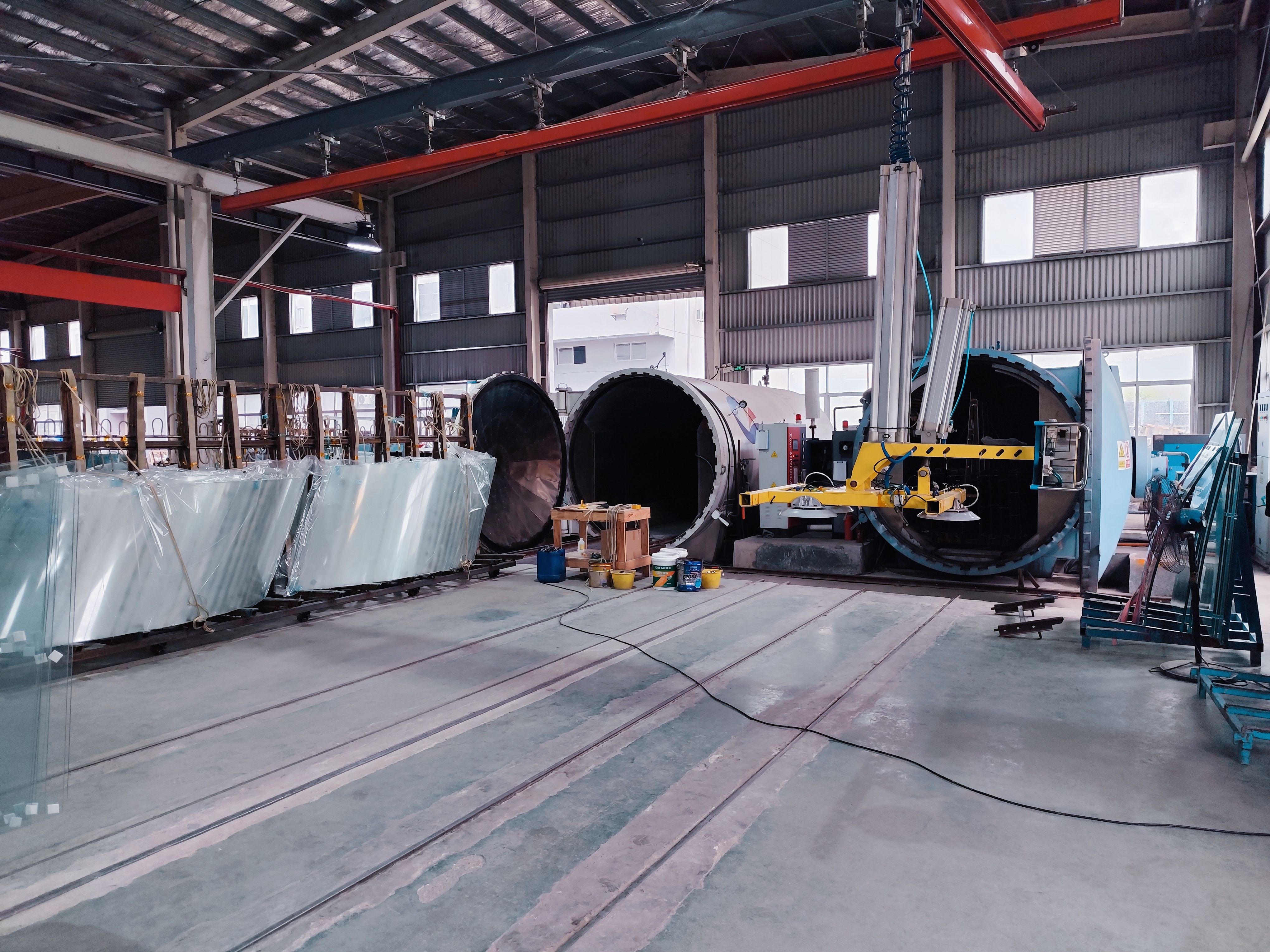
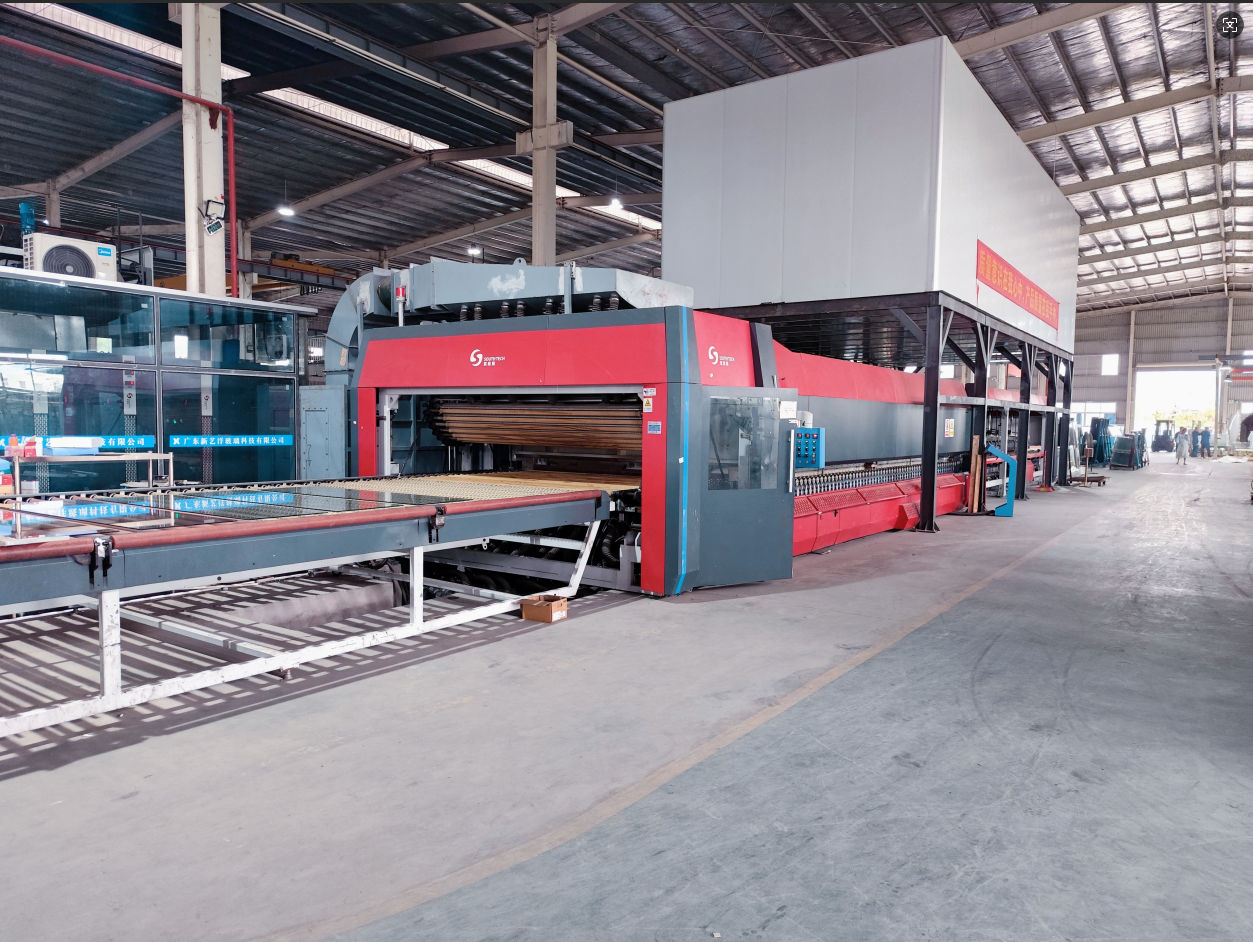
Autoclave line used for laminated glass bonding — relevant for interlayer specification verification.
Frequently asked questions
Which compliance standards and certifications apply to sound-insulation building glass in the EU market?
Three CE certifications apply to the product families used in acoustic building glass. Insulating glass (DY-ZK01) holds certificate BGTC20260403-05, issued by ECTI CERT Ltd. against EN 1279-1:2018, EN 1279-2:2018, EN 1279-3:2018 and EN 1279-4:2018. Laminated glass (DY-JJ01) holds certificate BGTC20260403-03 against EN 1449:2005. Tempered glass (DY-GH01) holds certificate BGTC20260403-02 against EN 12150-1:2015+A1:2019 and EN 12150-2:2004. All three are issued under the Construction Product Regulation 305/2011/EU (CPR) and are valid from 2026-03-03 to 2031-03-03 for the EU and EEA market. A specifier should verify each certificate number directly with ECTI CERT Ltd. and confirm that the certificate scope covers the ordered build-up.
Can a supplier customise an acoustic glass build-up for a specific project?
Yes. DYGLASS supports OEM and ODM production across size, thickness, shape, tempering treatment, insulating and laminated customisation, hot bending and bent tempering, coating options including heat insulation, Low-E and ceramic frit, low-iron glass, fire-resistant glass, and smart switchable glass. Because acoustic performance depends on the exact combination of glass mass, interlayer material and thickness, and cavity design, a custom acoustic build-up should be requested as a defined specification in the RFQ rather than as a general capability question.
What drives the cost difference between acoustic glass configurations?
The main cost drivers are glass type (insulating, laminated, or hybrid), glass thickness, interlayer material and thickness, spacer choice, gas fill, and panel size. Publicly reported European installation-cost data from 2024 gives USD 128 per square meter for laminated glass and USD 91 per square meter for tempered glass (EV-0005, EV-0006), but these figures do not distinguish acoustic performance specifically and should be treated as a general order-of-magnitude reference rather than a quote. The most reliable cost control method is to eliminate over-specification: identify the lowest-mass, thinnest configuration that still meets the tested acoustic target, rather than defaulting to the heaviest build-up.
How should a specifier validate a sample before bulk ordering?
Physical sample verification is the practical way to confirm that an acoustic configuration performs as expected before full volume production. A specifier should request samples representing each candidate build-up (insulating, laminated and hybrid) together with the tested acoustic data for the specific sample configuration. DYGLASS has a minimum order quantity of 10 square meters, which supports trial orders during specification. Where project-specific acoustic testing is required, this should be raised in the RFQ so that the sample and the tested build-up are matched.
What is the typical lead time for a sound-insulation building glass order?
DYGLASS states a production lead time of 7–9 days. This figure is stated at the capability level; curved, double-curved or specially configured acoustic builds may require a different schedule. A specifier should confirm the exact lead time by including the full build-up, quantity and destination in the RFQ. For acoustic projects where mock-up testing is planned, the sample and lead-time schedule should be confirmed together so that approval and production are aligned.
Conclusion: a repeatable comparison process, not a single number
Comparing building glass for sound insulation is not a matter of picking the highest dB figure on a datasheet. It is a matter of matching a construction type, glass mass, interlayer, spacer and gas fill to a defined noise environment, and then verifying that the configuration is backed by an in-scope certificate and a supplier who can produce it consistently.
The seven-step process in this guide — define the acoustic target, choose the construction type, specify thickness, select the interlayer, specify spacer and gas fill, verify compliance, and confirm supplier capability — provides a repeatable method that can be applied to any project. The two anchor product families from DYGLASS provide the reference point: insulating glass (DY-ZK01) with 30–45 dB and 6mm+12A+6mm / 8mm+16A+8mm standard build-ups, and laminated glass (DY-JJ01) with 35–45 dB, 6.38mm to 50mm overall thickness, and PVB, SGP or EVA interlayers from 0.38mm to 2.28mm.
For acoustic building glass projects in the EU and EEA market, the CE certificates BGTC20260403-05, BGTC20260403-03 and BGTC20260403-02 provide the compliance base. Each configuration still requires its own tested acoustic value and its own confirmation that the certificate scope matches the order.
Next step: to review the DYGLASS building glass range in detail, download the catalogue here: DYGLASS Building Glass Catalogue (PDF).
For acoustic configuration questions, sample requests or a project-specific quotation, contact DYGLASS:
- Website: www.dayangglass.com
- Email: info@dayangglass.com
- Tel: +86-136 9211 0212
- WhatsApp: +86-136 9211 0212
DYGLASS — Shenzhen Dayang Special Glass Co., Ltd., founded in 2017, operating a 30,000 m² factory with 130 employees and 600,000 square meters annual output.
Have Questions or Need More Details?
Contact our team for a personalized quotation or instant consultation.
Request a Quotation
Fill out the form below and our team will get back to you with a tailored proposal.
WhatsApp Direct Chat
Prefer to chat in real-time? Message us on WhatsApp for instant assistance & quick answers.
- Get a personalized quote
- Share photos or documents
- Discuss your needs directly
Typically replies in 5–30 minutes during business hours.