
Curved Glass Compliance Guide: Verifying Model-Level CE Scope and Standards
A CE mark on a curved glass proposal proves nothing until you can connect it to the exact model you are buying. This guide shows procurement teams how to move from a supplier's general compliance statement to a model-level check: the certificate number, the issuing body, the declared standard and edition, the EU/EEA applicability statement, and — most often missed — whether the certified scope actually covers curved variants of the product.
It is written for buyers at the Decision and Execution stage, where specifications are frozen, samples are approved and purchase orders are being drafted. At that point the question is no longer "is this supplier certified?" but "is this model, in this geometry, at this thickness inside the certified scope?" Those are different questions, and only the second one protects your project.
What "Model-Level CE Scope" Actually Means
Model-level CE scope means the certificate, declaration and supporting test evidence name the specific product family — and the specific model designation — that will be shipped to your site. Company-level compliance, by contrast, only tells you that an organisation holds some certification. It does not tell you which products, in which geometries, at which performance levels, are covered.
For curved architectural glass this distinction matters more than for flat glass. A bending line that produces a certified flat or single-curve product does not automatically extend certification to S-shaped, U-shaped, double-curved or extra-large panels, because the forming process, the stress distribution and the resulting optical and mechanical behaviour are different. A certificate that lists a product description without geometry limits leaves the buyer to guess where the boundary sits.
Why a company-level certificate is not enough
A company-level certificate answers a supplier-qualification question. A model-level certificate answers a product-conformity question. Project specifications, façade engineering approvals and customs or market-surveillance checks in the EU/EEA operate on the second question.
The practical test is simple: take the model designation on your purchase order and search for it in the compliance documents. If the designation does not appear, and the product description does not clearly encompass it, the claim is not yet verified — regardless of how prominent the CE logo is on the brochure.
The Compliance Problem: Generic Claims Versus Declared Scope
The most common failure in curved glass procurement is accepting a generic sentence such as "our glass is CE certified" as a substitute for a document review. Generic claims fail for three predictable reasons.
- Scope ambiguity. The certificate may cover a product family that the supplier interprets broadly and the buyer interprets narrowly. Only the written product description and any stated limitations resolve this.
- Variant drift. Certification obtained for one geometry or thickness range is often presented as covering the whole catalogue. Curved variants are the usual gap.
- Evidence substitution. A test report, a marketplace verification badge or a factory audit is offered in place of the model-specific declaration. These are useful, but they answer different questions.
None of these failures require bad faith. They usually come from documentation being assembled by sales teams rather than compliance teams. The buyer's job is to force the conversation back to documents that can be checked line by line.
Industry Background: How Curved Glass Fits EU/EEA Market Access
In the EU/EEA, construction products placed on the market are governed by the Construction Products Regulation and its CE marking framework. Under that framework, a manufacturer draws up a declaration of performance for the product, works to a declared standard or a European Technical Assessment, and operates factory production control so that the declared performance is maintained in serial production. CE marking is the visible output of that chain — not an independent quality award.
Two consequences follow for curved glass buyers.
First, the declared standard must be identified, including its edition. Standards are revised, and a declaration referencing an edition that has been superseded raises a documentation question even when the physical product is sound.
Second, the geometry question is a scope question. Public standards exist for bent building glass — for example, ASTM C1464-06 covers bent glass for building construction, furniture and display, and ISO 11485-3:2014 classifies curved tempered and curved laminated glass as safety glass for buildings. These show that curved glass is treated as a distinct product category with its own requirements, which is precisely why a flat-glass certificate cannot be assumed to transfer.
Market context explains why this is worth the effort. Global curved glass demand was estimated at USD 13.5 billion in 2025 with forecast growth around 5.8% across 2025–2035, and the adjacent glass curtain wall market was valued at USD 62.4 billion in 2024. Curved glass sits inside high-value façade work, where a compliance gap is discovered at the worst possible moment — during installation.
The DYGLASS Model Range: What Each Designation Covers
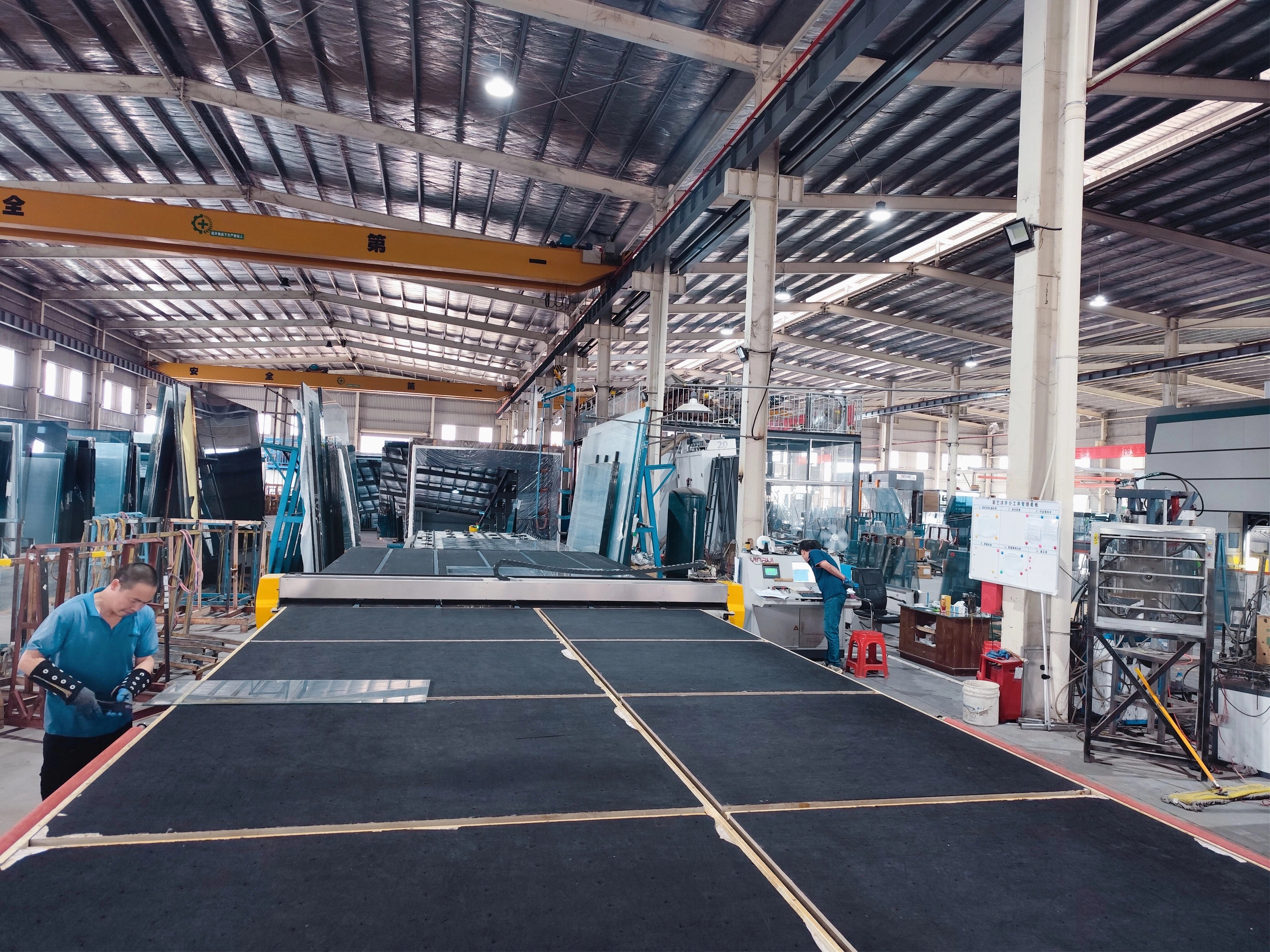
DYGLASS is the brand of Shenzhen Dayang Special Glass Co., Ltd., a Shenzhen-based processor of building glass founded in 2017, operating a 30,000 m² factory with 130 employees and an annual output of 600,000 square metres, exporting around 60% of production to markets including the UAE, Bahrain, Saudi Arabia, the United States, the Philippines and Vietnam. Its range includes laminated, toughened, smart, insulated and curved glass, and the company states that its multi-curved glass is certified to international standards including CE, SGCC and AS/NZS, and that it holds an SGS test report and Alibaba Verified Supplier status.
For compliance purposes, three model designations matter most in curved architectural work:
- DY-GH01 — the curved tempered (toughened) glass model. Relevant where safety glazing, thermal shock resistance and post-breakage fragmentation behaviour are specified.
- DY-JJ01 — the curved laminated glass model. Relevant where interlayer-based safety, residual load-bearing after breakage or acoustic and UV performance are specified.
- DY-ZK01 — the curved insulating glass unit model. Relevant where thermal and condensation performance, spacer and sealing integrity, and double-glazed build-up are specified.
Each designation is a distinct product family with its own declared performance. They should not be treated as interchangeable in a compliance review. A certificate or declaration covering DY-GH01 does not, by itself, establish anything about DY-ZK01.
Verification Workflow: Seven Checks Before You Accept a CE Claim
The workflow below is deliberately sequential. Each step produces a document or an answer you can file with the project record. If a step cannot be completed, the correct status is "not verified" — not "probably fine".
Step 1 — Freeze the model and the variant
Write down the exact model designation plus the geometry: shape family (cylindrical, S-shaped, U-shaped, double-curved, spherical), nominal thickness, dimensions, radius and any coating or interlayer. Compliance is checked against a defined article, not against a product idea. Anything not written down cannot be matched to a certificate scope later.
Step 2 — Match the certificate's product description to the order line
Read the product description on the certificate word by word. Ask the supplier to point to the sentence that covers your model. If the answer is "it is all included", ask for it in writing, with the page and clause identified. A written pointer is auditable; a verbal assurance is not.
Step 3 — Confirm the declared standard and its edition
The declaration should name the standard applied and the edition or year of that standard. Where a European Technical Assessment is used instead of a harmonised standard, the assessment reference should be stated. Record the edition so that it can be reviewed later if the standard is revised.
Step 4 — Confirm the certificate number and issuing body, then validate independently
Take the certificate number and the name of the issuing body directly from the certificate, and query the issuing body's own register rather than relying on a PDF supplied by the seller. Check that the certificate is current, that the manufacturer's legal name matches the contracting entity, and that the product scope in the register matches the copy you were given.
Step 5 — Check the EU/EEA applicability statement and the legal manufacturer
Confirm the geographical validity of the claim and the identity of the legal manufacturer. Where the seller is a trading company rather than the manufacturer, the certificate should still point to the production entity. A mismatch between the certificate holder, the manufacturer and the contracting party is one of the most common reasons a compliance file collapses at site level.
Step 6 — Test the curved-specific coverage
This is the step buyers skip. Ask directly: does the certified scope include curved variants, and if so, within which limits — minimum radius, maximum arc length, maximum panel size, shape families, thickness range? For models such as DY-GH01, DY-JJ01 and DY-ZK01, the answer should describe the geometry envelope, not merely confirm that curved glass is produced.
Step 7 — Cross-check the declaration of performance and factory production control
The declaration of performance and the production-control arrangements are what keep the declared values stable across a production run. Ask how dimensional and optical checks are recorded per batch, and what happens to a panel that falls outside tolerance. A supplier who can describe this process has a working system; a supplier who cannot has paperwork.
Where SGS Reports and Alibaba Verified Supplier Status Fit
Both are useful, and neither is a substitute for model-level CE documentation.
An SGS test report is a third-party test result. It tells you that a sample or a defined set of samples was tested, by a recognised laboratory, against stated criteria. It strengthens the technical case for a product and is often the most persuasive document a buyer receives. What it does not do is define the certified scope of a CE marking, because a test report is evidence of a test outcome, not a declaration of conformity and not a market-access instrument.
Alibaba Verified Supplier status is a platform-level verification of the business entity — a useful first filter when screening unfamiliar exporters, and a reasonable indicator that the company exists, trades and has been reviewed by a third party. It says nothing about the performance of a specific glass model.
The correct hierarchy is straightforward: the model-level CE certificate and declaration establish market access and declared performance; the SGS report supports the technical claims; the marketplace verification supports the credibility of the counterparty. Each answers a different question, and a strong file contains all three — in that order of authority.
Use Cases: Applying Model-Level Verification by Application
The same verification logic applies across applications, but the performance claim that needs checking changes.
Curved glass for curtain wall
Façade work carries the highest compliance exposure, because panels are structural, visible and difficult to replace. Verify that the certified scope covers the specified radius and panel size, and that wind-load performance is declared for the model rather than for the product family in general. DYGLASS states wind-pressure resistance up to 96 kPa for its multi-curved glass, a figure that should be tied to a specific model and test basis in the compliance file.
Curved glass for sightseeing elevator
Lift enclosures combine safety glazing requirements with tight geometric tolerances, since panels must fit a moving assembly. Check whether the declared scope covers the shape family used — cylindrical and double-curved enclosures are not the same article — and confirm the safety classification of the model being supplied.
Curved glass for shower room
Shower enclosures are safety-critical in a domestic setting and typically short-radius. Confirm that the certified scope extends to the small radii involved, and that the model designation on the order matches the declaration. This is where a flat-glass certificate is most often stretched beyond its real coverage.
Curved glass for coffee table
Furniture applications fall within the scope of bent-glass standards such as ASTM C1464-06, which explicitly addresses furniture and display alongside building construction. Buyers sourcing curved table glass should confirm that the applicable standard for furniture use is named, not only the architectural one.
Curved glass for skylight roof
Overhead glazing combines laminated or insulating build-ups with slope and drainage considerations. For DY-JJ01 and DY-ZK01, the compliance question is whether the declared performance covers the laminated or insulating configuration actually specified — interlayer type, cavity, spacer and edge seal — rather than the base glass alone.
Comparison Table: How Much Weight Each Document Carries
The table below sets out what each commonly supplied document establishes and what it leaves unresolved. It is a weighting framework for a compliance file, not a ranking of suppliers.
| Document | What it establishes | What it does not establish | Verification action |
|---|---|---|---|
| Model-level CE certificate and declaration of performance | That a named product model falls within a declared scope, against a named standard and edition, for the EU/EEA market | That every geometry or thickness variant in a catalogue is covered | Match model designation and geometry envelope; validate certificate number with the issuing body |
| SGS test report | That defined samples met stated test criteria at a recognised laboratory | Certified scope, market access, or serial-production conformity | Confirm the tested sample matches the ordered model and configuration |
| Alibaba Verified Supplier status | Third-party review of the business entity on a trading platform | Product performance, standard compliance or model coverage | Treat as an entity-level filter only |
| Supplier statement ("CE certified", "international standards") | That a claim is being made | Anything verifiable on its own | Request the underlying certificate and declaration before relying on it |
| Factory audit or production-control record | That a quality system exists and is operated | That a specific model conforms to a specific declared standard | Use as supporting evidence alongside the certificate |
Common Failure Modes and How to Close Them
In practice, compliance files fail in a small number of recurring ways. Each has a specific remedy.
- The certificate holder is not the manufacturer. Remedy: require a written statement of the manufacturing entity and confirm it matches the certificate.
- The product description is generic. Remedy: request a model-specific written confirmation referencing the certificate clause.
- Curved coverage is assumed, not stated. Remedy: ask for the geometry envelope in writing — radius, arc length, size and shape families.
- Standards edition is outdated. Remedy: request confirmation of the edition currently applied and the transition plan.
- Test report treated as certification. Remedy: separate the two documents in the project file and record what each one proves.
The general principle is that every claim in the compliance file should map to one document, and every document should map to one model. Where that mapping breaks, the gap is the risk.
Frequently Asked Questions
Does a CE certificate for flat tempered glass automatically cover curved tempered glass?
No. Certification applies to the product described in the certificate. Curved glass is treated as a distinct product category — ISO 11485-3:2014, for example, addresses curved tempered and curved laminated safety glass separately from flat products, and ASTM C1464-06 exists specifically for bent glass. A buyer must confirm in writing that the certified scope of a model such as DY-GH01 extends to the curved geometry being ordered, including the relevant radius and size limits.
What should I check first on a compliance document for DY-GH01, DY-JJ01 or DY-ZK01?
Start with the product description and the model designation. The document should name the product family and the declared standard, including the edition, and should identify the legal manufacturer. Once those three elements match your purchase order, move on to the certificate number and validate it with the issuing body directly. If the model designation does not appear and the description does not clearly encompass it, the claim remains unverified regardless of any accompanying test report.
Is an SGS test report or Alibaba Verified Supplier status a substitute for model-level CE documentation?
No, and the two serve different purposes. An SGS test report records that defined samples met stated test criteria at a recognised laboratory — it is technical evidence, not a declaration of conformity or a market-access document. Alibaba Verified Supplier status is an entity-level verification of the business on a trading platform and says nothing about the performance of a specific glass model. Both are worth having in the file, but the model-level certificate and declaration of performance remain the primary documents.
How do certification scope questions affect project cost and programme?
They affect both, mainly through rework and replacement risk. Curved panels are made to order, so a compliance gap discovered after installation is expensive to correct. Verification at the specification stage costs documentation review time; verification after delivery costs demolition, re-tempering and re-shipping. For context on production economics, DYGLASS states an ultra-precision bending tolerance in the range of ±0.5 mm to ±1 mm and installation loss held to about 2% for its multi-curved glass, compared with losses in the region of 5%–8% commonly cited for ordinary curved glass — figures that only hold if the specified geometry is genuinely inside the manufacturer's verified capability.
How should samples and documents be sequenced before a project order?
Run them in parallel, not in sequence. Request the model-level certificate, declaration of performance and test evidence at the same time as the physical sample, so that the sample you approve is the article described in the documents. Approving a sample whose model designation and geometry are not reflected in the compliance file creates a gap that surfaces later. DYGLASS states a standard lead time of 7–12 days for its curved glass production, so document review can usually be completed inside the sample and approval window rather than adding to the programme.
What is the single most useful question to ask a curved glass supplier?
Ask them to point to the sentence in the certificate that covers your model, your geometry and your thickness — in writing. Suppliers who hold genuine model-level documentation answer this quickly and precisely. Suppliers who hold only general claims answer with adjectives. That single question, asked early, resolves most of the compliance risk described in this guide. If you want to run it against a live project, you can request the model-level documentation set and a matched sample from DYGLASS for DY-GH01, DY-JJ01 or DY-ZK01.
Conclusion: Verify the Model, Not the Brochure
CE compliance for curved glass is a document-matching exercise. The certificate must name the product, the standard must be declared with its edition, the issuing body must be independently checkable, the EU/EEA applicability must be explicit, and the scope must reach the curved variants you are actually buying. Everything else — test reports, marketplace badges, factory photographs — supports that core file without replacing any part of it.
For buyers working with DY-GH01, DY-JJ01 or DY-ZK01, the practical next step is to request the documentation set together with the sample, then run the seven checks in this guide against the exact geometry on the drawing. Done at the specification stage, it takes hours. Done after installation, it takes a programme.
Next Step: Request the Model-Level Documentation Set
DYGLASS supplies curved tempered, laminated and insulating glass for façade, elevator, sanitary, furniture and rooflight applications, and exports to markets including the UAE, Saudi Arabia, Bahrain, the United States, the Philippines and Vietnam. Procurement teams can request the compliance documentation for a specific model together with a matched sample and quotation.
Email info@dayangglass.com · WhatsApp +86 136 9211 0212 · Website www.dayangglass.com
Download the full product catalogue: DYGLASS Curved Glass Catalogue (PDF)
Have Questions or Need More Details?
Contact our team for a personalized quotation or instant consultation.
Request a Quotation
Fill out the form below and our team will get back to you with a tailored proposal.
WhatsApp Direct Chat
Prefer to chat in real-time? Message us on WhatsApp for instant assistance & quick answers.
- Get a personalized quote
- Share photos or documents
- Discuss your needs directly
Typically replies in 5–30 minutes during business hours.