
Curved Glass Datasheet Decoded: Thickness, Tolerance, Transmittance, Interlayer, Spacer and CE Marks
A curved glass datasheet is read in six passes: thickness, tolerance, light transmittance, interlayer, spacer/cavity, and CE marking. Each line only carries meaning when it is read against the build-up it belongs to — a monolithic tempered pane, a laminated pane, or an insulated unit. This guide decodes all six using the specification sets of three DYGLASS models: DY-GH01 (curved tempered glass), DY-JJ01 (curved laminated glass) and DY-ZK01 (curved insulated glass).
DYGLASS is the brand of Shenzhen Dayang Special Glass Co., Ltd., a Shenzhen-based building glass processor founded in 2017 that operates a 30,000 m² factory with 130 employees, produces laminated, toughened, smart, insulated and curved glass, and exports around 60% of its output to markets including the UAE, Bahrain, Saudi Arabia, the United States, the Philippines and Vietnam.
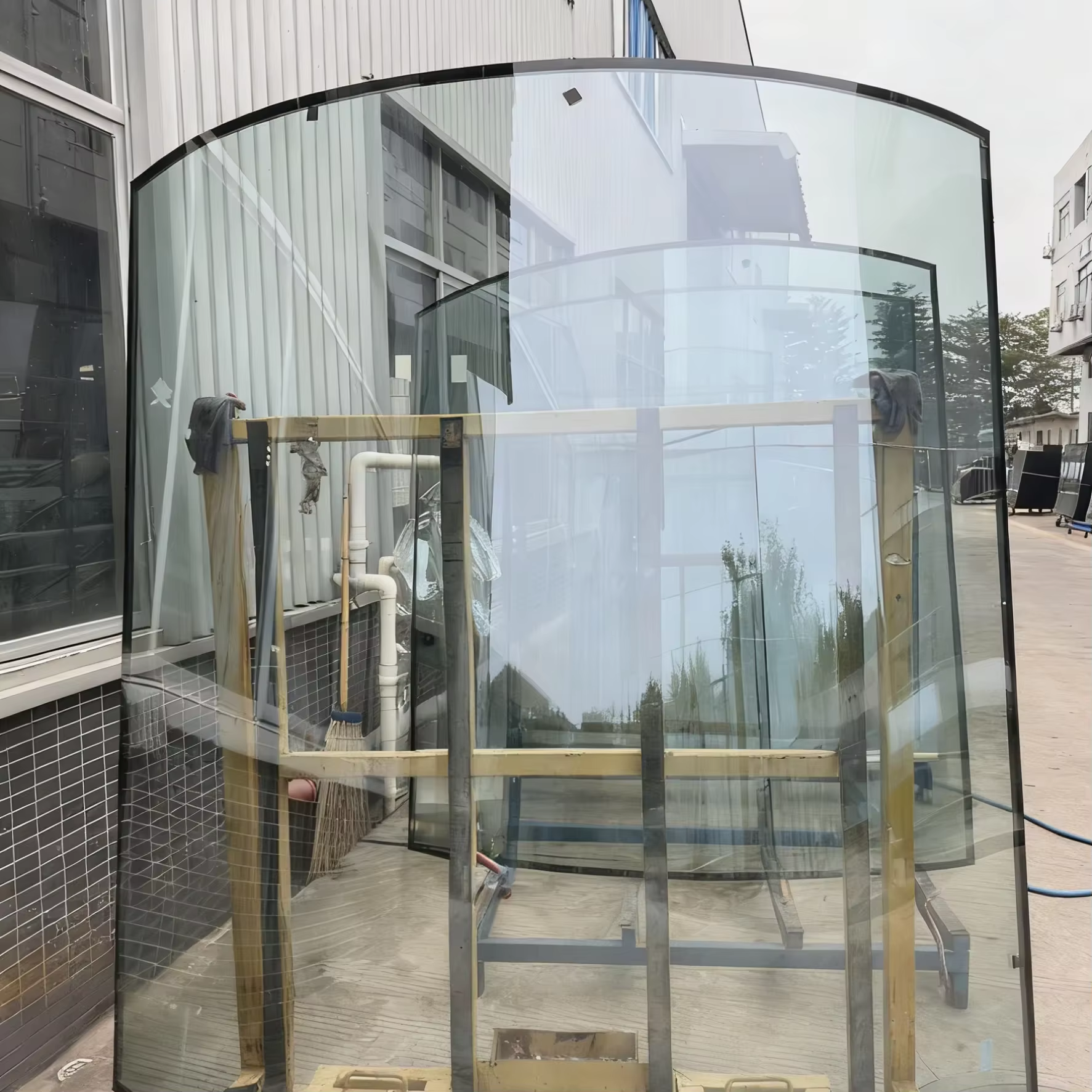
Problem Definition: Why Curved Glass Datasheets Are Misread
Specification errors on curved glass rarely come from bad products. They come from reading a parameter without reading the structure around it. Three misreadings account for most of them.
1. Thickness is read as one number across three different meanings. On a monolithic curved tempered pane, thickness describes the glass itself. On a curved laminated pane, the quoted figure is a finished thickness that already contains the interlayer. On a curved insulated unit, thickness is a build-up written as glass + cavity + glass. The three figures are not interchangeable, and a 12 mm monolithic unit cannot substitute for a 6.38 mm laminated one on the basis of a single “12 mm” line item.
2. Light transmittance is compared across non-comparable build-ups. A transmittance figure is a property of the whole assembly — substrate, coating, interlayer and cavity — not of the glass alone. Comparing a monolithic value against an insulated value produces a decision error before any supplier is contacted.
3. A CE mark is treated as a single certificate. A CE mark on curved glass refers back to specific harmonised standards for the specific construction. A mark without the standard numbers behind it cannot be checked by a specifier or a notified body, and it does not tell a buyer which tests were applied.
Industry Background: Where Curved Glass Specifications Sit
Curved glass is a specialised segment inside a much larger architectural glass market, and its specification language is inherited from flat glass standards that had to be adapted for bending.
Commercial research published by Statifacts estimates the global curved glass market at USD 13.5 billion for 2025, with a forecast growth rate of 5.8% across 2025–2035. For context, Grand View Research reports the glass curtain wall market at USD 62.4 billion in 2024 — the sector that consumes most architectural curved glass, particularly in facades where curvature is a design requirement rather than a finish option.
Two standards are commonly cited as the reference frame for bent glass. ASTM C1464 covers bent glass requirements for building construction, furniture and display applications. ISO 11485-3:2014 classifies curved tempered and curved laminated glass as safety glasses for buildings. Neither standard replaces a supplier datasheet: they define test and classification frameworks, while the datasheet states what a specific product actually delivers.
For EU and EEA projects, the datasheet is normally written against the harmonised European standards for the specific construction: EN 12150-1:2015+A1:2019 for thermally toughened safety glass, EN 1449:2005 for laminated safety glass, and EN 1279-1/-2/-3/-4:2018 for insulated glass units covering the unit as a whole, its properties, its long-term performance and its conformity assessment. A buyer’s first check should therefore be whether the datasheet names the standard that matches the product type quoted.
Detailed Solution: The Six Parameters, Decoded
1. Thickness — identify which of the three thickness types you are reading
DY-GH01, curved tempered glass, is specified across 3 mm, 4 mm, 5 mm, 6 mm, 8 mm, 10 mm, 12 mm, 15 mm and 19 mm. This is a single-pane range, so the number in the datasheet is the glass as formed and tempered.
DY-JJ01, curved laminated glass, is specified as a finished thickness range of 6.38 mm to 50 mm. The 0.38 mm step at the bottom of that range is the signature of a laminated build-up: it is the smallest PVB interlayer added to two glass plies. When you read 6.38 mm on a DY-JJ01 line, you are reading glass + interlayer, not glass alone.
DY-ZK01, curved insulated glass, is written as a build-up, not a single figure. The standard configurations are 6 mm + 12A + 6 mm and 8 mm + 16A + 8 mm, with custom build-ups available. Here “12A” and “16A” denote the air or gas cavity rather than glass thickness, which is why an insulated specification that lists only one number is incomplete.
Reading rule: before comparing two datasheets, confirm whether each thickness figure describes a pane, a laminate or a unit. Only figures of the same type can be compared.
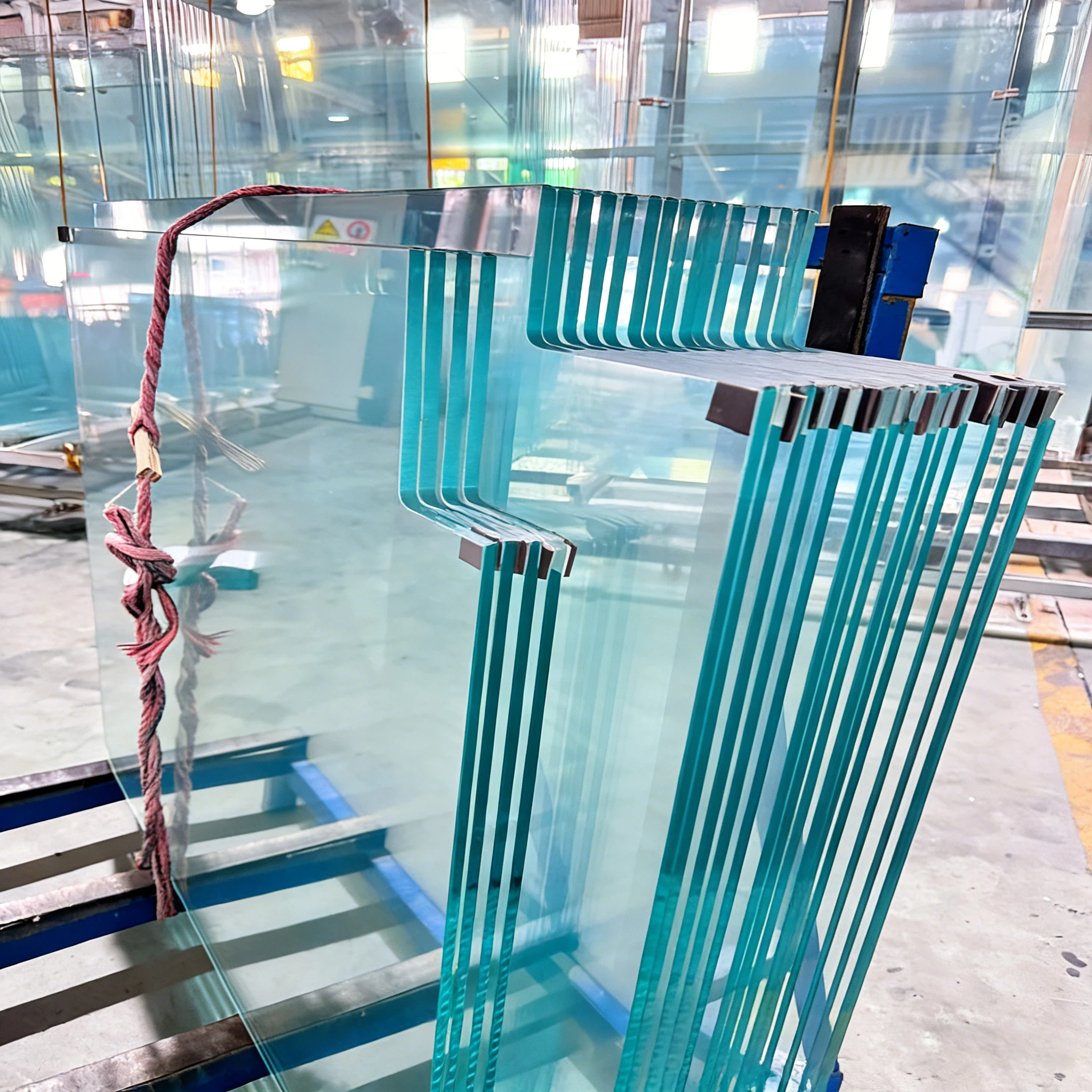
2. Tolerance — the only line that defines acceptance
Tolerance is the parameter that converts a datasheet into an inspection criterion. DY-GH01 is specified at ±0.5 mm. That single figure is what a factory inspector, a glazing contractor and a project QA team can all test against with the same instrument.
For curved glass specifically, tolerance matters most where the pane meets a frame, a gasket or an adjacent panel. An S-shaped or double curved unit that sits within its dimensional tolerance will close a joint cleanly; the same unit outside tolerance transfers the deviation to the silicone joint or the pressure plate. Buyers should treat a datasheet without a stated tolerance as incomplete rather than as generous.
3. Light transmittance — read the substrate, not just the percentage
The three DYGLASS families publish transmittance at three different levels because they are three different optical systems:
- DY-GH01 curved tempered glass: light transmittance ≥ 91%.
- DY-JJ01 curved laminated glass: 85%–92% for clear builds, 10%–70% for tinted builds, with glass substrate options of tempered, float, low-iron and tinted glass.
- DY-ZK01 curved insulated glass: 70%–89%, with glass type options of clear float, low-E, tempered and low-iron.
The practical consequence is that a project targeting a specific daylight level must fix the substrate and coating before comparing transmittance values. Low-iron glass raises clarity; tinted substrate lowers it deliberately; a low-E coating in an insulated unit changes the figure again. The percentage is a result, not an input.
4. Interlayer — where safety, sound and UV behaviour are set
DY-JJ01 is a tempered laminated construction in which the interlayer choice does most of the performance work. The datasheet exposes three interlayer materials — PVB, SGP and EVA — with PVB available in 0.38 mm, 0.76 mm, 1.14 mm, 1.52 mm and 2.28 mm thicknesses. The same product family also covers bulletproof laminated glass and fire-resistant laminated glass variants.
Interlayer thickness is not a cosmetic upgrade. It is the parameter that a buyer selects when post-breakage behaviour, acoustic damping or laminate stiffness matters. Sound insulation for the DY-JJ01 range is stated at 35 dB to 45 dB — a range that only becomes meaningful once the interlayer and substrate are fixed on the same line of the specification.
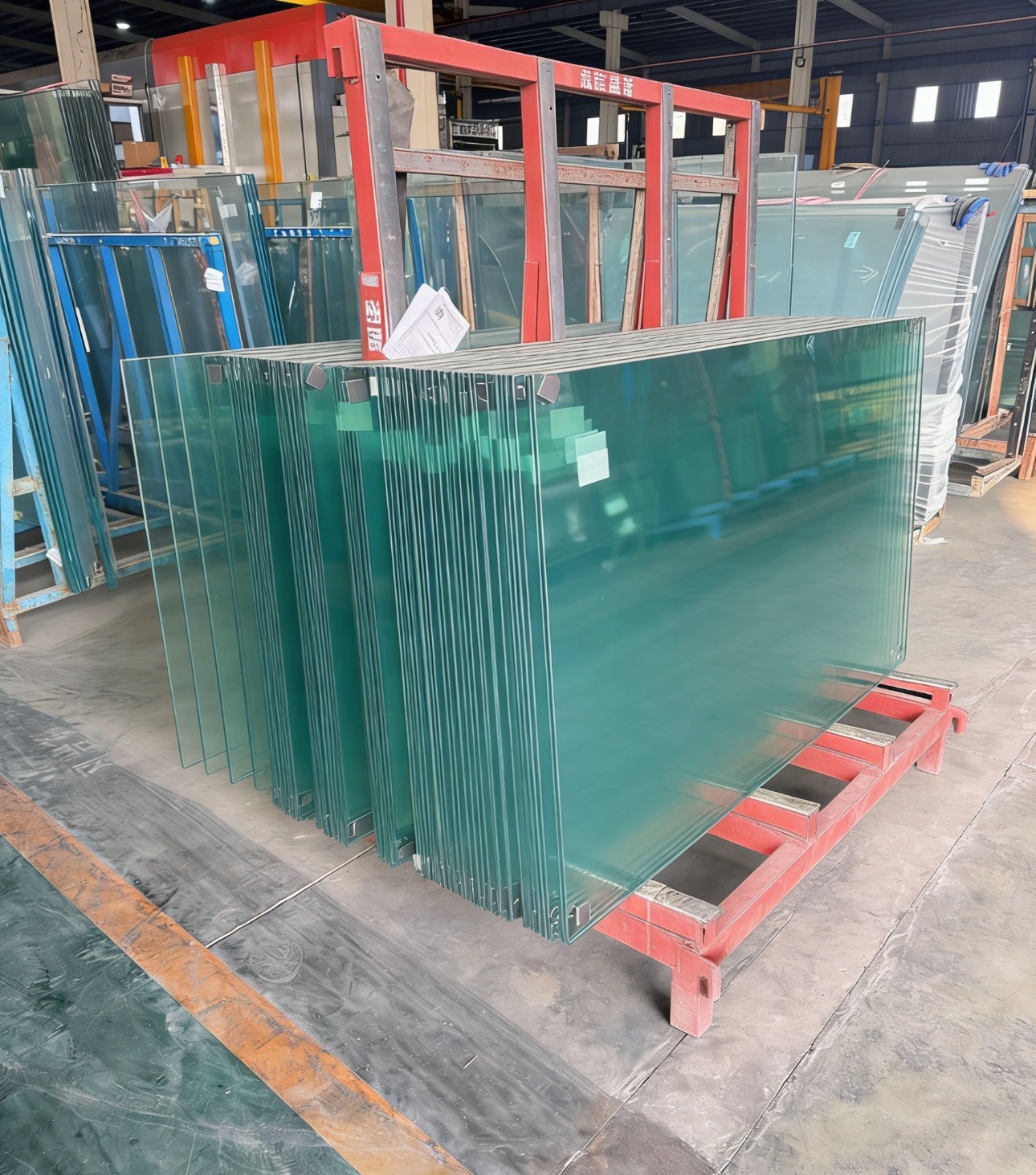
5. Spacer and cavity — the part of an insulated datasheet buyers skip
DY-ZK01 is a tempered insulated construction available with low-E coating and with argon gas fill. The datasheet names the components that determine thermal and acoustic performance:
- Spacer bar: aluminum spacer or warm edge spacer.
- Gas fill: air, argon, krypton or xenon.
- Build-ups: standard 6 mm + 12A + 6 mm and 8 mm + 16A + 8 mm, custom available.
- Sound insulation: 30 dB to 45 dB.
Two units can both read “tempered insulated glass with low-E” and still behave differently, because the spacer type and gas fill sit between the glass plies. When a project brief specifies acoustic performance, the 30–45 dB band should be read together with the cavity width and gas fill on the same specification line, not as a guaranteed value for the product family as a whole.
6. Edge work — the line that decides whether the pane can be installed
DY-GH01 lists edge work as polished, grinded or beveled. Edge treatment is a fabrication variable, not a finish detail: it determines how the glass interfaces with a clamp, a shoe, a hinge or an exposed edge condition. A datasheet that omits edge work leaves the last manufacturing step open, and that step is usually where schedule slippage appears.
7. CE marking — check the standard behind the mark
For EU and EEA supply, the CE mark on a curved glass datasheet should be traceable to the harmonised standard for that construction. In practice that means three checks:
- Toughened curved glass — the datasheet should reference EN 12150-1:2015+A1:2019.
- Laminated curved glass — the datasheet should reference EN 1449:2005.
- Insulated curved glass — the datasheet should reference EN 1279-1/-2/-3/-4:2018, which addresses the unit, its properties, its long-term performance and its conformity assessment.
A single product family that spans laminated and insulated constructions therefore needs more than one standard reference. If a datasheet shows a CE mark but only one standard number for a laminated-plus-insulated scope, the marking scope should be clarified before the document is accepted into a project submittal.
Step-by-Step Breakdown: Reading a Curved Glass Datasheet in Seven Passes
- Identify the construction first. Decide whether the line describes a monolithic pane (DY-GH01), a laminate (DY-JJ01) or an insulated unit (DY-ZK01). Every later parameter is interpreted through this choice.
- Fix the thickness type. Record whether the figure is a pane range (3–19 mm), a finished laminate range (6.38–50 mm) or a build-up (6 mm + 12A + 6 mm; 8 mm + 16A + 8 mm).
- Write down the tolerance. For DY-GH01 this is ±0.5 mm. Any datasheet without a stated tolerance is not yet an inspection document.
- Pair transmittance with its substrate. ≥ 91% for DY-GH01; 85%–92% clear or 10%–70% tinted for DY-JJ01; 70%–89% for DY-ZK01. Never compare these three figures against each other without matching substrate, coating and build-up.
- Lock the interlayer or the cavity. For laminates, select PVB, SGP or EVA and a PVB thickness from 0.38, 0.76, 1.14, 1.52 or 2.28 mm. For insulated units, select aluminum or warm edge spacer and air, argon, krypton or xenon fill.
- Confirm edge work. Polished, grinded or beveled — matched to how the pane is retained in the frame or fitting.
- Verify the standard reference. EN 12150-1:2015+A1:2019, EN 1449:2005 or EN 1279-1/-2/-3/-4:2018, according to the construction actually quoted.
Use Cases: Which Parameters Matter in Which Application
Curved glass for construction, decoration and municipal engineering projects draws on a wide glass mix — multi-curved tempered, flat tempered, laminated, insulated, electric controlled, digital printing and painted or stained glass — with bulletproof, fire-resistant and special-shaped glass handled as special requirements. The parameter that decides the datasheet changes with the application.
Curved glass for curtain wall. The controlling line is the insulated build-up: DY-ZK01 at 6 mm + 12A + 6 mm or 8 mm + 16A + 8 mm, with low-E coating, argon fill, aluminum or warm edge spacer, and a 30–45 dB sound insulation band. Curvature complexity in facades often runs into double curved and no wave distortion requirements, which are shape questions rather than thickness questions.
Curved glass for sightseeing elevator. Laminated construction dominates here because the pane is both structural and exposed: DY-JJ01 between 6.38 mm and 50 mm, PVB interlayer at 0.76 mm to 1.52 mm depending on the design intent, sound insulation stated at 35–45 dB. Cylindrical, S-shaped and U-shaped geometries are all within the curved forming envelope DYGLASS describes.
Curved glass for shower room. Edge work is the first line to read, not the last: polished or beveled edges on DY-GH01, with thickness selected from the 8 mm, 10 mm or 12 mm options in the range. Explosion-proof and special-shaped variants fall under the special requirement category rather than the standard datasheet line.
Curved glass for coffee table. Optical quality dominates. Low-iron substrate and a clear laminated build-up give 85%–92% transmittance, and the interlayer protects the surface condition in a furniture application where edges are fully visible.
Curved glass for skylight roof. Overhead glazing combines the insulated unit with a laminated inner or outer ply, so both the spacer/gas line and the interlayer line must be read. UV block and sound insulated variants are specified at the assembly level, not the pane level.
Comparison Table: DY-GH01 vs DY-JJ01 vs DY-ZK01
| Datasheet parameter | DY-GH01 — curved tempered | DY-JJ01 — curved laminated | DY-ZK01 — curved insulated |
|---|---|---|---|
| Thickness / build-up | 3, 4, 5, 6, 8, 10, 12, 15, 19 mm | 6.38 mm – 50 mm finished thickness | 6 mm + 12A + 6 mm / 8 mm + 16A + 8 mm (custom available) |
| Tolerance | ±0.5 mm | Not stated in the datasheet set | Not stated in the datasheet set |
| Light transmittance | ≥ 91% | 85%–92% clear; 10%–70% tinted | 70%–89% |
| Interlayer | Not applicable (monolithic) | PVB, SGP, EVA; PVB 0.38 / 0.76 / 1.14 / 1.52 / 2.28 mm | Not stated in the datasheet set |
| Spacer & gas fill | Not applicable | Not applicable | Aluminum or warm edge spacer; air / argon / krypton / xenon |
| Sound insulation | Not stated in the datasheet set | 35 dB – 45 dB | 30 dB – 45 dB |
| Edge work | Polished / grinded / beveled | Not stated in the datasheet set | Not stated in the datasheet set |
| Coating / gas options | Float glass substrate | Tempered, float, low-iron, tinted substrate | Clear float, low-E, tempered, low-iron; argon fill available |
| Relevant CE standard reference | EN 12150-1:2015+A1:2019 | EN 1449:2005 | EN 1279-1/-2/-3/-4:2018 |
Only parameters published in the DYGLASS specification sets are listed. Fields marked “not stated” should be confirmed directly against the project-specific datasheet before submittal.
FAQ
Which CE standards should a curved glass datasheet reference for EU or EEA projects?
The reference depends on the construction. Thermally toughened curved glass is referenced to EN 12150-1:2015+A1:2019, laminated curved glass to EN 1449:2005, and insulated glass units to EN 1279-1/-2/-3/-4:2018, which covers the unit, its properties, its long-term performance and its conformity assessment. A supplier offering more than one construction should be able to show more than one standard reference. ASTM C1464 and ISO 11485-3:2014 are separate frameworks for bent glass and for the classification of curved tempered and curved laminated safety glass.
Can one supplier handle S-shaped, U-shaped and double curved geometries within the same specification?
DYGLASS processes multi-curved, double curved, triple curved, trapezoid curved, spherical curved, pyramidal curved, S-shape curved, cylindrical curved and positive-and-negative curved tempered glass, so the forming geometry and the datasheet parameters are specified together rather than separately. The datasheet still governs acceptance: thickness, ±0.5 mm tolerance on DY-GH01, transmittance, interlayer or spacer selection and edge work each remain individual lines to be confirmed.
What drives the cost of curved glass when reading a datasheet?
Cost follows the parameters that add material and process steps: thicker panes within a range such as 3–19 mm on DY-GH01, additional or thicker interlayers such as 1.52 mm or 2.28 mm PVB on DY-JJ01, low-E coating and argon or krypton fill on DY-ZK01, warm edge versus aluminum spacer, and edge work beyond a standard finish. Because these variables sit on separate datasheet lines, two quotations for what looks like the same “curved glass” can describe different assemblies. Fixing all six parameters before requesting pricing is the only way to compare offers on equal terms.
How should a buyer validate a sample before production?
The sample should be built to the same specification lines the project will be inspected against — construction type, thickness or build-up, interlayer material and thickness for laminates, spacer and gas fill for insulated units, and edge work. Validating a sample that differs on any of these lines tests a different product. A sample request is a specification exercise, not a formality, and it is the point at which open parameters should be closed.
How do unresolved datasheet parameters affect lead time?
Production cannot be scheduled until the six parameters are fixed, because each one changes material pick, forming setup and finishing. A laminated unit with PVB thickness unspecified, or an insulated unit quoted without a decision between aluminum and warm edge spacer, remains an open item. Buyers who issue a complete parameter set — thickness type, tolerance requirement, transmittance target with substrate, interlayer or spacer selection, edge work and the applicable CE standard — remove the most common cause of schedule delay before the order is placed.
To move from datasheet reading to a project-specific quotation, send the full parameter set with your drawing to DYGLASS at info@dayangglass.com or request a sample built to the exact build-up under evaluation via WhatsApp +86 136 9211 0212.
Conclusion: A Datasheet Is a Set of Linked Decisions
The six parameters on a curved glass datasheet are not independent. Thickness type determines which tolerance figure is meaningful; substrate and coating determine whether a transmittance value can be compared; interlayer or spacer selection sets the sound and thermal behaviour; edge work decides whether the pane can be installed; and the CE standard reference is only valid when it matches the construction actually quoted.
Read in that order, the DY-GH01, DY-JJ01 and DY-ZK01 specification sets become a decision sequence rather than a list: 3–19 mm tempered panes at ±0.5 mm for monolithic and fitting-critical work, 6.38–50 mm laminated builds with PVB, SGP or EVA for safety and acoustic duty, and 6 mm + 12A + 6 mm or 8 mm + 16A + 8 mm insulated units with low-E, argon and aluminum or warm edge spacer for facade and roof applications.
Shenzhen Dayang Special Glass Co., Ltd. produces these families in a 30,000 m² facility and welcomes OEM and ODM orders; the full product documentation is available in the DYGLASS catalogue, and the company profile is published at www.dayangglass.com.
Next step: decode your own specification with us
Send your drawing and the six parameters you have already fixed. DYGLASS will confirm the build-up, the applicable CE standard reference and the sample arrangement for your evaluation.
Request a quotation | info@dayangglass.com | Download catalogue
Have Questions or Need More Details?
Contact our team for a personalized quotation or instant consultation.
Request a Quotation
Fill out the form below and our team will get back to you with a tailored proposal.
WhatsApp Direct Chat
Prefer to chat in real-time? Message us on WhatsApp for instant assistance & quick answers.
- Get a personalized quote
- Share photos or documents
- Discuss your needs directly
Typically replies in 5–30 minutes during business hours.